What do ketchup bottle caps have to do with origami and robotics? At Princeton Engineering, the answer is geometry. Engineers found that the same hinge that keeps a ketchup cap open also explains how curved, folded shells can hold multiple stable shapes, a discovery that led them to build a robot that shifts shape and motion using magnets alone, no motors required.
In an article published June 15, 2026, in the Proceedings of the National Academy of Sciences, a research team led by Glaucio Paulino demonstrated a method for creating adjustable shells that can snap into a variety of configurations. Each configuration is stable — it can maintain its position and resist outside force without additional locking mechanisms.
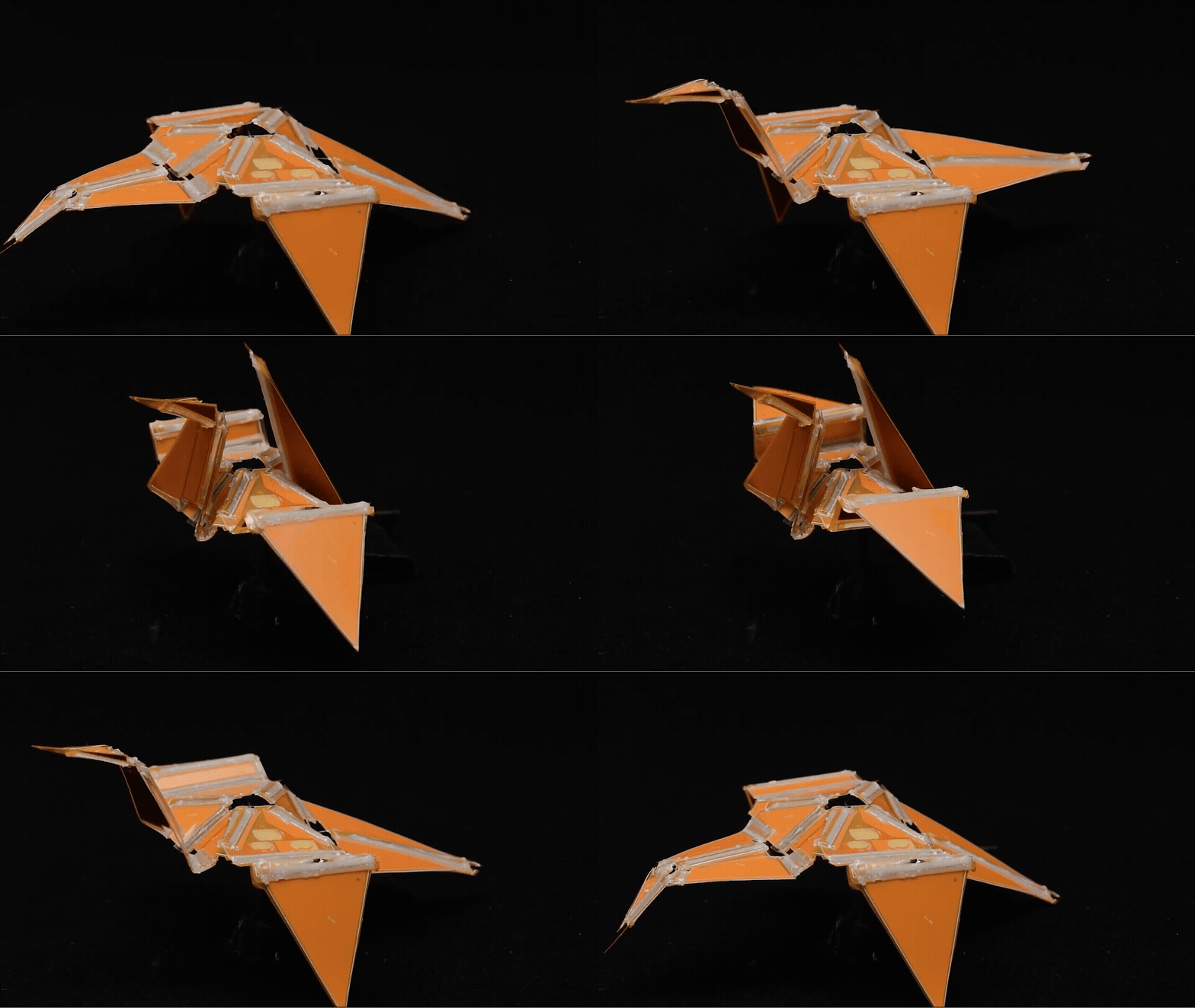
The researchers derived mathematical rules that predict how such folds behave, then used those rules to build a magnetically controlled robot that can roll, crawl and change shape. Their design leverages multistable states to give each robot its own active and inactive modes, which allows independent control of each robot despite a common magnetic field for all robots. Paulino said that geometry puts everything together and allows curvature, folding and stability to interact naturally.
“Geometry is the real actuator here,” he said. “Instead of relying on complicated mechanisms, we use mathematical principles to encode multiple stable configurations directly into the structure. That opens a new pathway for designing lightweight, adaptable systems.”
The paper’s lead author, graduate student Kevin Liu, said the work relies on the same principle that allows the plastic bottle caps on ketchup to snap open and closed. A design that attaches a thin, flexible shell to a thick, rigid cap along a curved edge creates two stable states separated by an energy barrier. This bi-stability keeps the cap open while you apply your ketchup, preventing a mess.
“We saw these plastic caps that are so commonly used and asked the question, where does the bi-stability come from, and can we learn some fundamental principle to create more general multistable structures?” Liu said.
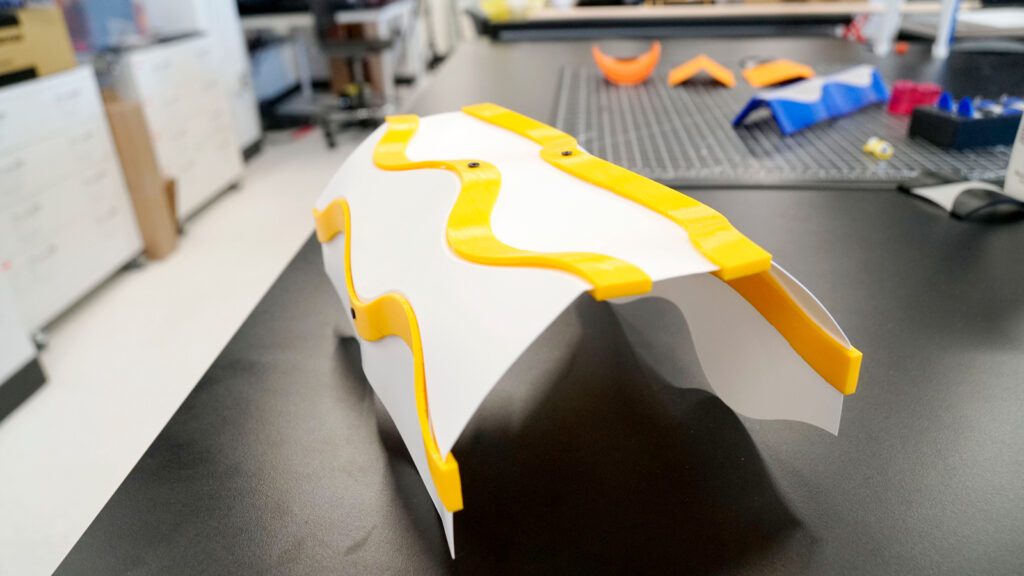
The researchers used the mathematical framework behind origami to derive the rules for their new system. Origami typically deals with straight lines and sharp, folded creases, but a version of origami works with curved lines to create looping shapes. Curved-crease origami has been used in art for at least a century, but Liu said that mathematicians have only recently developed frameworks that can define the curved structures.
Curved creases are useful for creating shells, thin structures with a curved surface. Shells are extremely efficient ways to carry a load over a wide area. They exist in nature, as eggshells or skulls, in the built environment as bridges and machine parts, and in ancient buildings like the Roman Pantheon and the Hagia Sophia.
The researchers first prepared a geometric and mathematical analysis and found that when a curved edge of a shell is fixed, there are only two configurations for the shell which are possible without stretching the surface. These can become the two stable states in a bistable structure. Then, the researchers built protypes using laser cutting and 3D printing and found that additional stable states existed besides the two predicted by the theory.
“We were surprised to find that rather than only having two stable states, our samples had six or more,” Liu said. “We realized that in order to minimize energy, the structure was naturally concentrating deformation into a thin band, effectively creating a new crease without any human input.”
The researchers termed this deformation band a pseudocrease, an area where energy from bending and stretching the shell compete and balance. The team went back to their mathematical work and analyzed pseudocreases to understand how this balance of stretching and bending scales with the size of the structure. Ultimately, they were able to recreate the phenomenon in simulations.
The researchers said that their system does not depend on special processing or exotic materials, because the behavior derives from rules of geometry that can be applied to common materials at a variety of length scales and surface shapes. Using their design method, the team created concepts for reconfigurable architecture, snapping boxes, and toggling electrical switches – in addition to their magnetically controlled robots.
“In engineering, some of the most transformative advances often come from discovering simple principles that explain seemingly unrelated phenomena,” Paulino said. “Here, the same mathematics connects artistic curved-crease origami, everyday bottle caps, robotic locomotion, and deployable structures. Finding those unifying principles advances research and teaching in unique and elegant ways.”
The article, Actuation driven pseudo-crease mechanics in multistable curved-crease origami shells, was published June 15, 2026 in the Proceedings of the National Academy of Sciences. Besides Liu and Paulino, authors include Tomohiro Tachi of the University of Tokyo. Support for the project was provided in part by the Princeton-UTokyo Strategic Partnership, National Science Foundation, the Princeton Catalysis Initiative (PCI), Japan Society for the Promotion of Science (JSPS), and Japan Science and Technology Agency (JST).