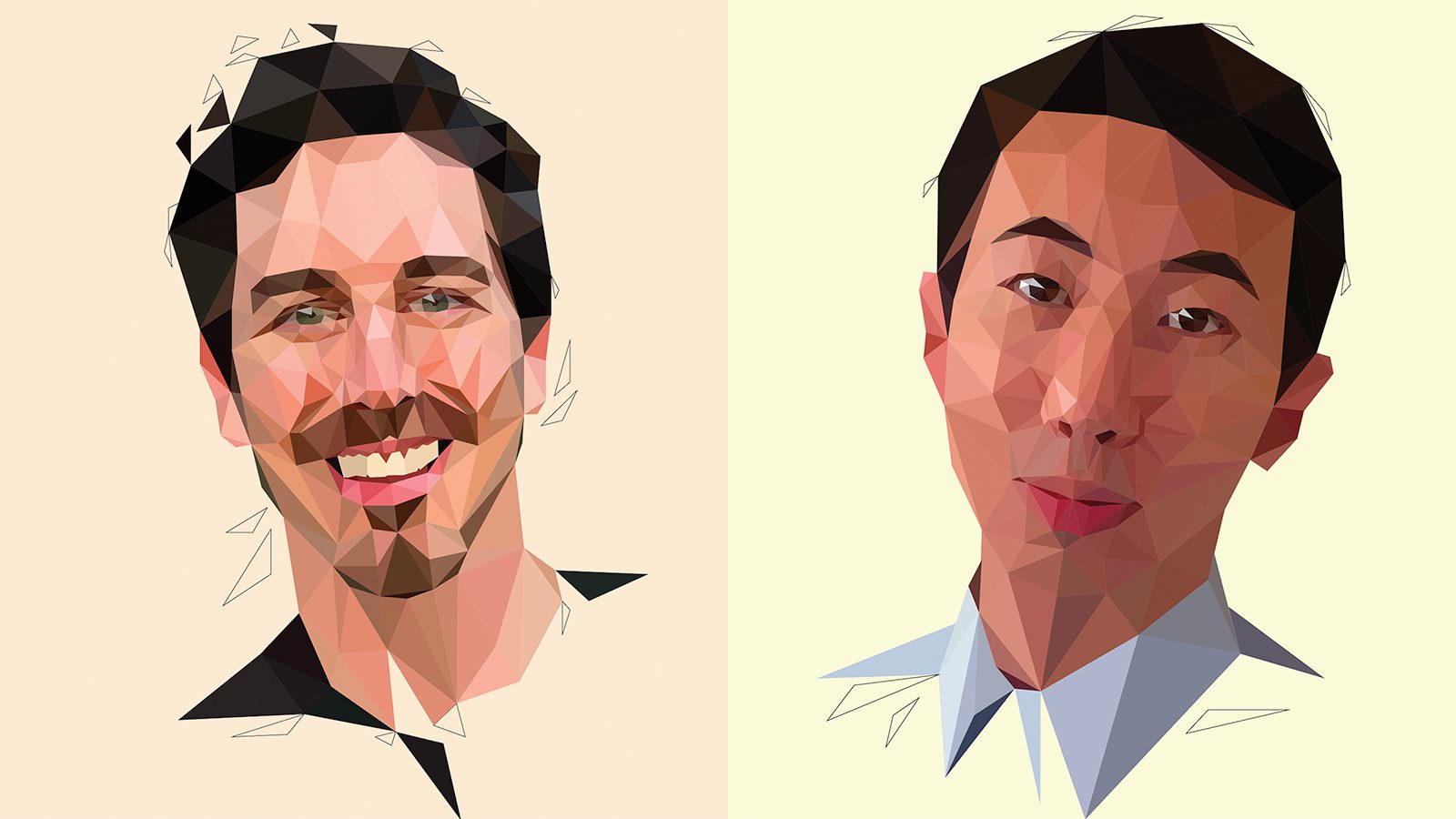
Scientific American has named Dane deQuilettes and Kaiyi Jiang to the inaugural cohort of Young American Scientists, recognizing their work in clean-energy technologies and AI-driven drug discovery, respectively.
The Young American Scientists is a group of “28 early-career scientists based in the U.S. who are changing the world with their work,” according to the magazine’s announcement. Scientific American was founded in 1845 and is the oldest continuously published magazine in America. The editorial staff will host an event celebrating the work of this inaugural cohort on June 18.
DeQuilettes, an assistant professor of electrical and computer engineering, designs new materials at the nanoscale for solar energy harvesting and quantum sensing. His lab develops advanced microscopy tools to probe how electrons behave in materials such as perovskites, a class of ultra-thin semiconductors with exceptional optical and electrical properties. And he has created some of the highest quality lab-grown diamonds ever made, a material that promises to transform emerging quantum information technologies. He earned a Ph.D. from the University of Washington and was a postdoctoral researcher at the Massachusetts Institute of Technology. He was then a member of the technical staff at MIT Lincoln Lab from 2021 to 2023. DeQuilettes was previously named to Forbes’ 30 Under 30. He is a cofounder and serves as the Chief Scientist for Optigon, Inc., a clean-energy company. He is associated faculty in the Princeton Plasma Physics Laboratory and the Princeton Materials Institute. He joined Princeton in 2026.
Jiang, an assistant professor of bioengineering, uses AI to develop next-generation tools for cellular engineering and therapeutics development. He combines machine learning and molecular engineering techniques to manipulate molecules and cells, hoping to better understand how diseases work on a molecular level. With this knowledge, Jiang seeks to engineer therapeutics that address aging and diseases like cancer and autoimmune disorders. Prior to Princeton, Jiang was the inaugural Science Fellow at Amgen. He earned a Ph.D. from MIT. In 2023 he won the Wishnok Prize from MIT and in 2024 he was named to the MIT Technology Review Innovators Under 35 list. He will join the Princeton faculty in July, where he will be a core faculty member in the Omenn-Darling Bioengineering Institute.
DeQuilettes was selected for advancing the understanding of perovskites and their use in energy, and Jiang was selected for his work using artificial intelligence in drug discovery. They will be featured in the July/August issue of Scientific American.