AI models are good at finding answers to mathematical puzzles but are not as good at research judgment, according to theoretical computer scientists.
The researchers, co-led by Princeton’s Pravesh Kothari, documented their use of AI in a case study shared on arXiv, outlining the ways in which AI tools excelled and fell short in reaching an important solution to an open mathematical problem.
AI is excellent at finding answers, they argue, because the models are trained on published papers, textbooks and solved problems. But, as of August 2026, these models were not as good at the process of recognizing the value of a theoretical result over numerical evidence or determining the significance, generality or downstream use of a result, according to the authors. This is because training data rarely includes information on the long process of mathematical discovery, which includes failed approaches, unlikely results and changes in strategy.
Using AI tools, the researchers successfully narrowed the bounds of the Grothendieck constant, a mathematical concept first identified by Alexander Grothendieck in 1953. The paper that details the math research is not yet peer reviewed, but the results have implications for creating more efficient algorithms in graph theory and quantum information.
Kothari, associate professor of computer science and a senior author on the paper, called the Grothendieck constant “a beautiful problem.”
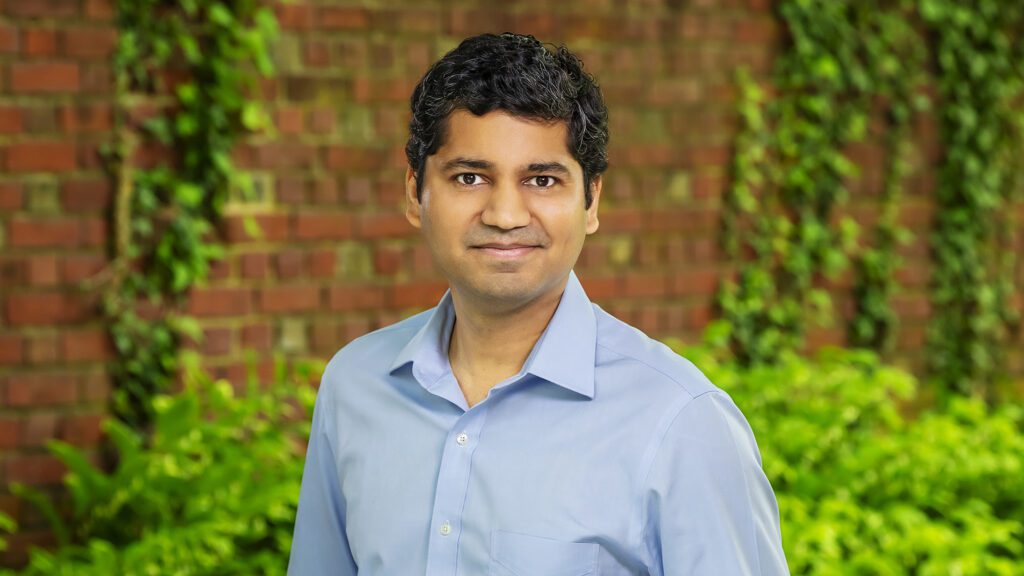
“The interesting bit is that we can take very little credit for the research as human beings,” said Kothari. AI models did most of the work, he said, with humans providing guidance only when the models got stuck. “If I had the same level of involvement on a paper last year, I would not be listed as an author,” he added.
To do the work, the team set up a system with two models: a reasoning model to do the math and a coding agent to verify the math proposed by the reasoning model. The humans posted instructions to a bulletin that the agents would read periodically.
The models were set up to run through the problem in iterations while maintaining a permanent memory to improve upon previous work. Around iteration 18, the researchers noticed that the models were stuck — they were essentially looping and unable to move ahead. The humans intervened and redirected the agents by reframing the question. After about 30 additional iterations, the model succeeded in narrowing the bounds of the constant.
Mathematicians are increasingly using AI and frontier labs are racing to solve some of the greatest open math problems. Recent highlights include OpenAI disproving Paul Erdős’s 1946 unit distance conjecture and solving the Navier-Stokes problem, one of seven open Millennium Prize Problems.
These AI advances have caused an upheaval in the field. Mathematics has long revolved around finding solutions to important hard problems. Typically, this discovery process takes years and involves dozens of workshops, seminars, and peer-reviewed papers. The process of discovery happens alongside the search for the answer.
AI solutions have upended this system — the answers are simply announced, and researchers are left to decipher them.
With the Navier-Stokes solution, OpenAI released a 166-page proof that has been verified by Lean, an automated theorem prover, but not by humans, according to Science. The Erdos unit-distance conjecture was verified by humans, OpenAI announced, but the model used to solve it is still not available for public use.
Mathematicians largely agree that AI is outpacing humans at finding answers, but they disagree about what this means for the field. Some, like Jacob Tsimerman, a 2026 recipient of the Fields Medal and a 2011 Princeton graduate alumnus, argue that math can’t be maintained as a discipline if AI replaces humans at solving hard problems. Just hours after winning the Fields Medal, Tsimerman announced he was leaving the University of Toronto to join OpenAI.
Others, like Terence Tao, a 2006 Field Medalist and 1999 Princeton graduate alumnus, see math as a community process, something that AI solutions can’t replace. AI has generated 100,000 line proofs that are largely incomprehensible, Tao said in a recent lecture at the Simons Foundation. “It is not enough to generate and verify the proofs. The proofs need to be explained well enough that they can be communicated and understood by the community.”
If math solutions are meant to advance human knowledge it’s necessary for humans to understand those solutions, argues a recent letter written by 25 Fields Medalists. In the rush to solve problems, the letter states, AI labs have neglected to advance broader mathematical understanding.
At this moment, Kothari said, he sees the publicly available AI models as extremely effective assistants. In the case of his work on the Grothendieck constant, what would have taken years for humans took only weeks for an AI model working continuously. “Realistically, what would’ve happened is that we would’ve given up somewhere along the way,” said Kothari. “But these models don’t get frustrated.”
AI has changed how Kothari approaches both teaching and research. He was trained, for example, to approach hard questions in small, incremental steps. “If I want to solve some major complexity theory problem, I don’t usually start working on that problem. I break it up into pieces,” he said. This is also how he has traditionally trained his students.
Without working through those smaller problems, students don’t get to practice working on challenging but solvable larger questions. “The kind of starter projects I used to have for my first-year graduate students, I can’t really use them anymore,” Kothari said. These projects are the math equivalent of gym reps, he said — students need to lift a lot of 10-pound problems before they can move on to weightier questions.
“The optimistic take is that this is momentary, that we will recalibrate and have a different notion of what research steps should be,” said Kothari. “The pessimistic take is people will stop working towards solving a big mathematical problem because they’re worried that they’re going to get scooped by a model in three months.”
The case study, Long-Horizon AI Research for Grothendieck Constant: A Case Study in Human–AI Mathematical Collaboration, was posted to arXiv on August 14. In addition to Kothari, the authors include Raghu Meka at the University of California-Los Angeles and Alan Li, Rahul Saha, Anton Xue, Swarat Chaudhuri and Adam Klivans at the Univeristy of Texas-Austin.