Princeton University researchers will lead two U.S. government-backed projects, one to develop advanced wireless sensing and communications capabilities and another to improve an emerging semiconductors’ durability.
Each project includes researchers from multiple universities and will receive approximately $7.5 million in funding over the next five years. They are two of 20 related projects announced by the Defense Department on Oct. 29, totaling $150 million in funding, as part of its Multidisciplinary University Research Initiative, or MURI.
“By deploying a mix of perspectives and approaches, MURI projects foster the kind of bold, cross-cutting research that can spark breakthroughs and push the boundaries of what’s possible,” Jason Day, a Department research policy director, said in a statement announcing the grants.
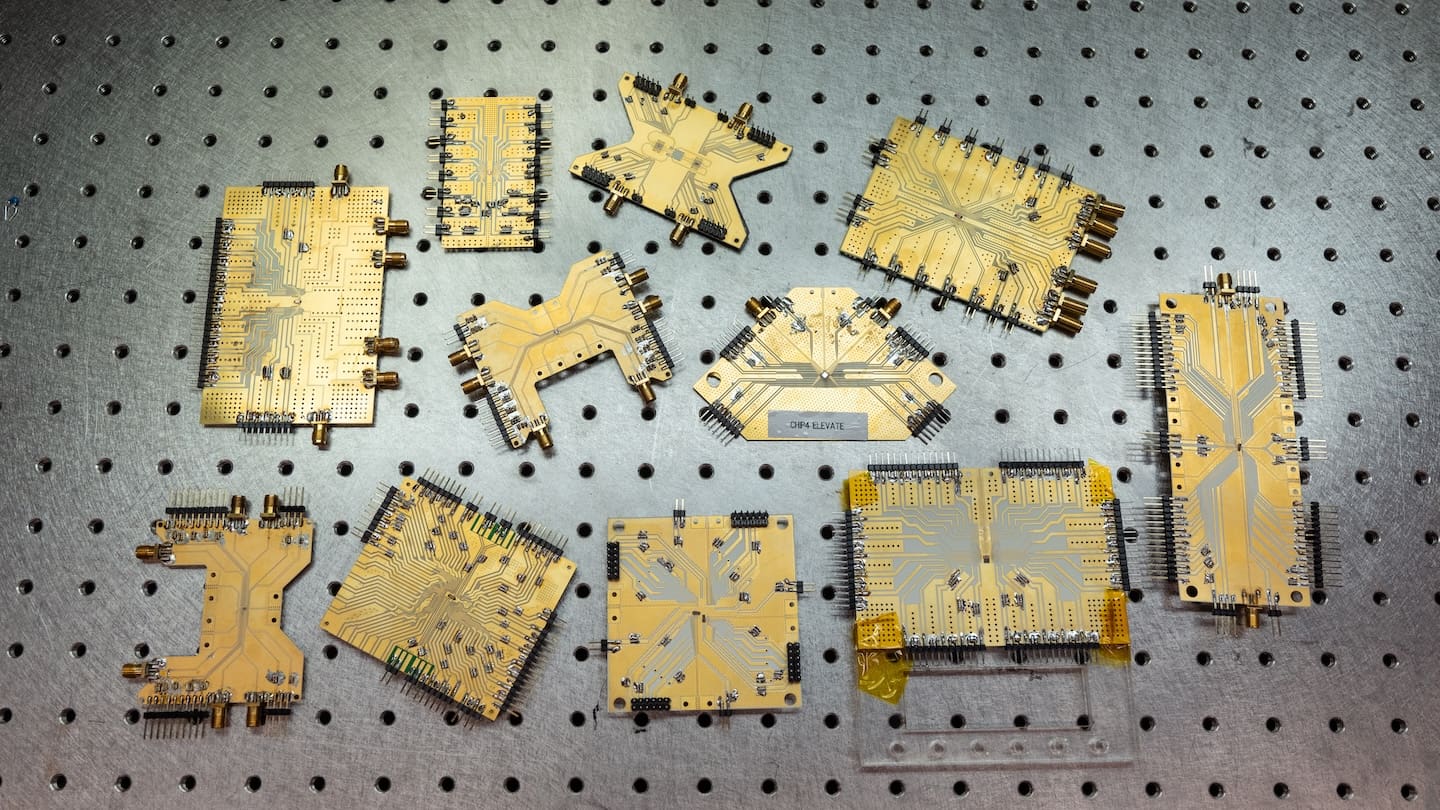
Kaushik Sengupta, professor of electrical and computer engineering, will lead the project seeking to rethink high-frequency wireless systems designs. Conventional approaches to building antennas and electromagnetic interfaces are reaching their limits as technologies advance, including high-frequency signals, space-based networks and large devices.
“For decades, we have designed these radio-frequency systems in largely the same way. But are these really the best architectures? What if we started from the fundamental laws of physics and mathematics to discover entirely new ways of transmitting, receiving, and controlling wireless signals?”
The team includes researchers from five universities, including co-principal investigator Alejandro Rodriguez from Princeton’s Department of Electrical and Computer Engineering, along with collaborators from Harvard University, Stanford University, Caltech, and the University of California-San Diego.
Barry Rand, professor of electrical and computer engineering and Andlinger Center for Energy and the Environment, will lead the project focused on the durability of halide perovskites, a class of semiconductors that show promise in optoelectronic devices including solar energy applications.
The team includes researchers from the University of Colorado-Boulder, Georgia Tech, Johns Hopkins University, Northwestern University and University of Washington. They will study the electrochemical processes of perovskites in their relevant technological environments, looking for ways to stabilize these materials under working conditions. “Halide perovskites are remarkably good at turning sunlight into electricity,” Rand said. “We want to understand the chemistry that makes them break down in working devices and find ways to slow that damage or even reverse it.”