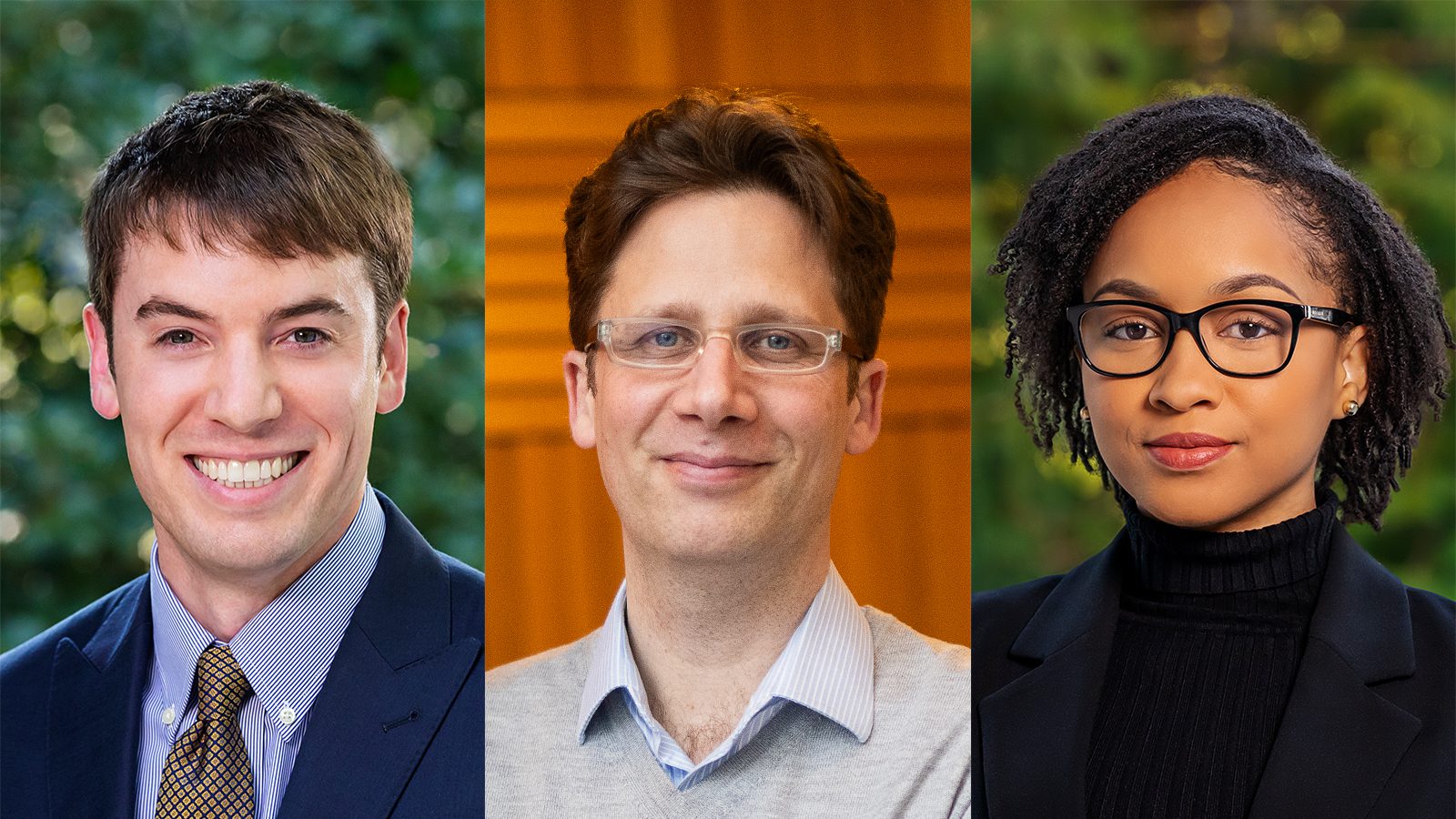
Three engineering professors have been recognized for their exceptional mentorship of graduate and undergraduate students during the past year.
Jonathan Conway received the 2026 Excellence in Mentoring Award from the School of Engineering and Applied Science; Tom Griffiths and Jerelle Joseph each received a 2026 Graduate Mentoring Award, co-sponsored by the Graduate School and the McGraw Center for Teaching and Learning.
Graduate students and former students nominate faculty for the annual awards. Conway was the sole recipient of this year’s mentoring award from the engineering school. Griffiths and Joseph were among four recipients of the Graduate School-McGraw Center award; the other faculty recognized this year were Edward Baring, professor of history and human values and Jamie Rankin, University lecturer in the German Department.
Jonathan Conway
Excellence in Mentoring Award, sponsored by Princeton’s School of Engineering and Applied Science

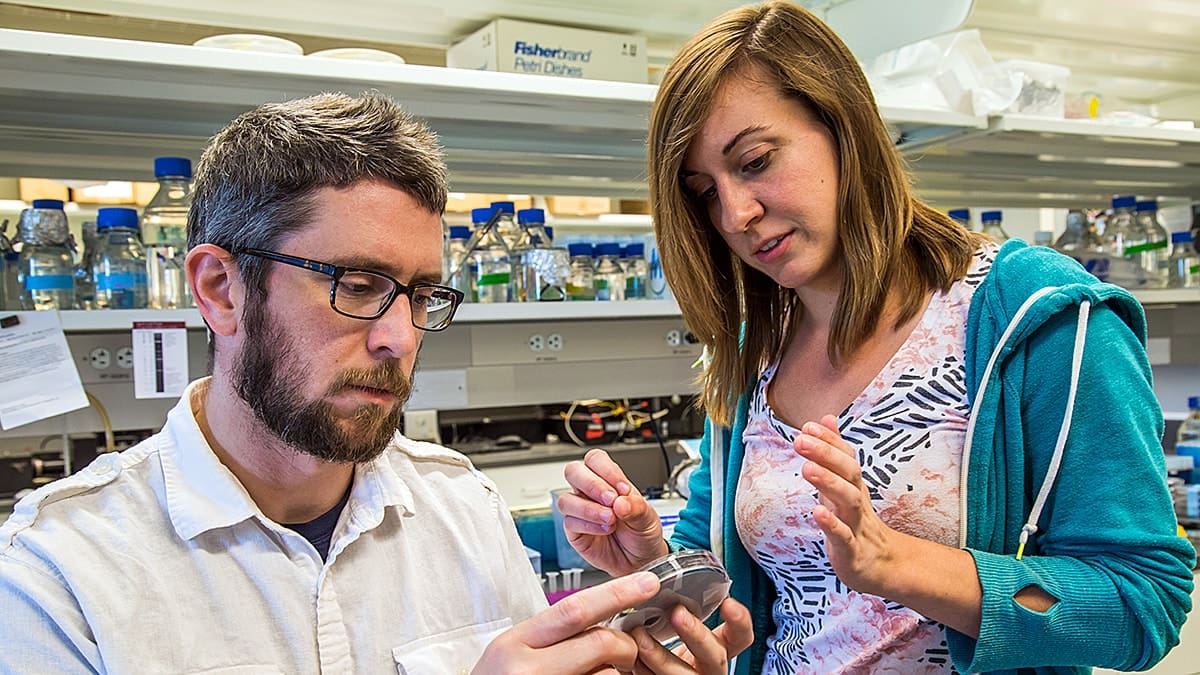
Plant-microbe interactions shape much of life on Earth, but the interfaces between plants and microbes are only beginning to be understood. Conway leads a group of researchers in studying plant-microbe interactions by engineering both the genes and the chemical and biological pathways that regulate these organisms — from crops to chemical feedstocks. He joined Princeton in 2021 and his group currently consists of four postdocs, five graduate students and four undergraduates.
One graduate student said Conway’s approach “has enabled me to grow in my confidence to ask questions and share ideas,” despite struggling to speak up in group settings as an undergraduate student.
Another said Conway is “driven, first and foremost, by a genuine commitment to training the next generation of scientists.”
Several students highlighted Conway’s patience and availability as a mentor, praising his ability to see through problems and the delight he has taken in the details of their projects.
One said that Conway’s impact as a mentor was clear: “I am more ambitious and confident in the scope of questions I hope to tackle.”
Tom Griffiths
Graduate Mentoring Award, co-sponsored by the McGraw Center for Teaching and Learning and the Princeton Graduate School

Griffiths, the Henry R. Luce Professor of Information Technology, Consciousness, and Culture, is the director of the Computational Cognitive Science Lab and, since September 2024, the inaugural director of the Princeton Laboratory for Artificial Intelligence. When he came to Princeton in 2018, he was the first faculty member to be jointly appointed in the departments of Psychology and Computer Science.
Many of the more than a dozen current and former students who nominated Griffiths wrote that they were impressed by his ability to focus on their individual research interests in the classroom and the laboratory as they pursue their careers. Several said that Griffiths has built a culture in his lab that encourages students to be innovative and independent thinkers. “He creates an environment that is intellectually vibrant,” one student said, and also infused with warmth.
Nominators also praised Griffiths as a mentor who gives generously of his time, meeting with students individually every week, offering thoughtful, incisive and personally tailored guidance on their research and pointing them toward papers that speak directly to their work.
Griffiths “has given me a research path that is both exciting and deeply connected to the questions that first drew me to this field,” one nominator wrote. “He has opened doors I did not know existed, offered guidance without agenda, and shown a quiet, consistent care for my growth as both a scientist and a person.”
Jerelle Joseph
Graduate Mentoring Award, co-sponsored by the McGraw Center for Teaching and Learning and the Princeton Graduate School

Joseph’s research explores how liquid-like compartments inside cells form and function, and how these processes can be harnessed in bioengineering to engineer cellular behavior and develop new therapies. She joined the University in 2023 as an assistant professor of chemical and biological engineering and is jointly appointed in the Omenn-Darling Bioengineering Institute.
Joseph won praise from graduate students for creating a welcoming environment in her classroom and laboratory where students can genuinely thrive, and for the support she provides beyond the lab.
“It is no understatement to say that Professor Joseph has been the most supportive, encouraging, positive mentor and Ph.D. adviser that I could have ever hoped for,” one student wrote.
Joseph brings that same attentiveness to her classroom, tailoring her teaching to individual learning styles and meeting one-on-one with students in her lab every week.
Joseph also champions her students’ futures, encouraging them to pursue fellowships and other professional development opportunities.
One mentee’s reflection best captures the impact of Joseph’s guidance of her students: “I am so incredibly happy at Princeton, I find my work meaningful, and I am basking in the opportunity to learn. This is all because of my Ph.D. mentor.”