Howard Stone, a pioneer in fluid dynamics, has been awarded the 2027 Julius Edgar Lilienfeld Prize by the American Physical Society.
Stone, the Neil A. Omenn ’68 University Professor of Mechanical and Aerospace Engineering, was awarded for “defining and solving outstanding and relevant problems in fluid physics, fluid mechanics, and soft matter physics, and for exceptional skill in lecturing, both to experts and to the public, to convey the beauty and elegance of science.” He will be honored at the APS Medal and Society Prize Ceremony and Reception in Washington, D.C., on January 28, 2027.
Stone is internationally recognized for his pioneering research in fluid dynamics and its applications across engineering, chemistry, physics and biology. His contributions to microfluidics, the manipulation of fluids at the microscale, helped lay the foundation for lab-on-a-chip technologies used in rapid diagnostics and chemical analysis. He has developed models to improve water purification, advanced understanding of microorganism movement and biofilm behavior with implications for health and disease control, and helped reveal the important role underground fungal networks play in the environment. His discoveries also extend to the behavior of gels, with implications for manufacturing and 3D printing. During the COVID-19 pandemic, Stone and his colleagues made direct visualization of the fluid flows generated by speech, showing how such interactions can provide pathways for pathogen transmission by aerosols. A prolific scholar, he has published nearly 700 articles since the mid-1980s, garnering more than 100,000 citations.
One of the American Physical Society’s most prestigious honors, the Lilienfeld Prize recognizes individuals who have made outstanding contributions to physics and demonstrate exceptional skill in communicating the field to diverse audiences.
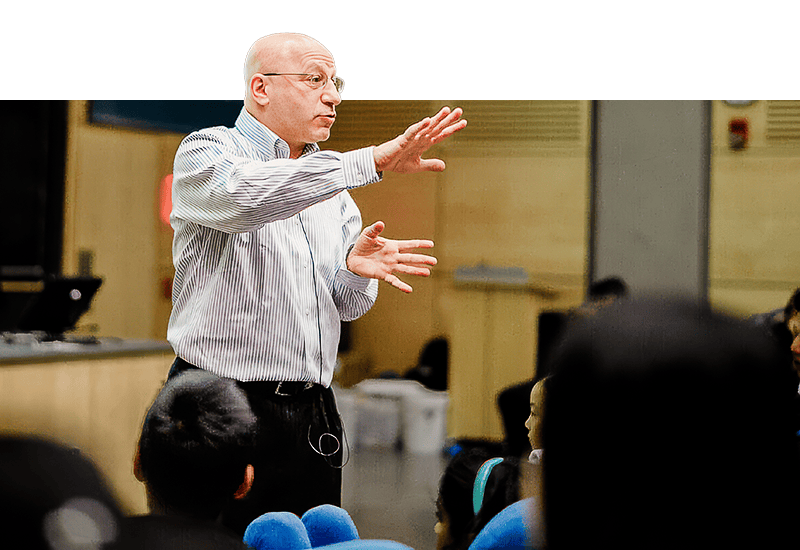
For Stone, that commitment to communication extends well beyond the classroom and laboratory. For more than two decades, he has worked to bring the excitement of scientific discovery to young audiences through the Holiday Lecture series, an annual science outreach program he established at Harvard University in 2002 and later brought to Princeton. This December, the series celebrates its 25th anniversary.
Over the years, the Holiday Lecture series has evolved, incorporating new ideas while remaining rooted in an approach inspired by the Royal Institution’s long-running Christmas Lectures: making science visual, engaging and relevant through familiar experiences. Stone’s program has grown to include four lectures every December, two at Princeton and two at Harvard, drawing more than 1,000 attendees in total each year.
“I hope it has inspired some children to consider science and engineering as one path for their future,” said Stone.
Stone was elected a Fellow of the American Physical Society in 2003. He is also a member of the National Academy of Engineering, the American Academy of Arts and Sciences and the National Academy of Sciences and is a foreign member of the Royal Society of the United Kingdom. Stone is an associate faculty member in the Princeton Materials Institute, the Omenn-Darling Bioengineering Institute and the Program in Applied and Computational Mathematics. Stone received his doctorate from the California Institute of Technology and was the Vicky Joseph Professor of Engineering and Applied Mathematics at Harvard University before joining the Princeton faculty in 2009 as the Donald R. Dixon ’69 and Elizabeth W. Dixon Professor of Mechanical and Aerospace Engineering.