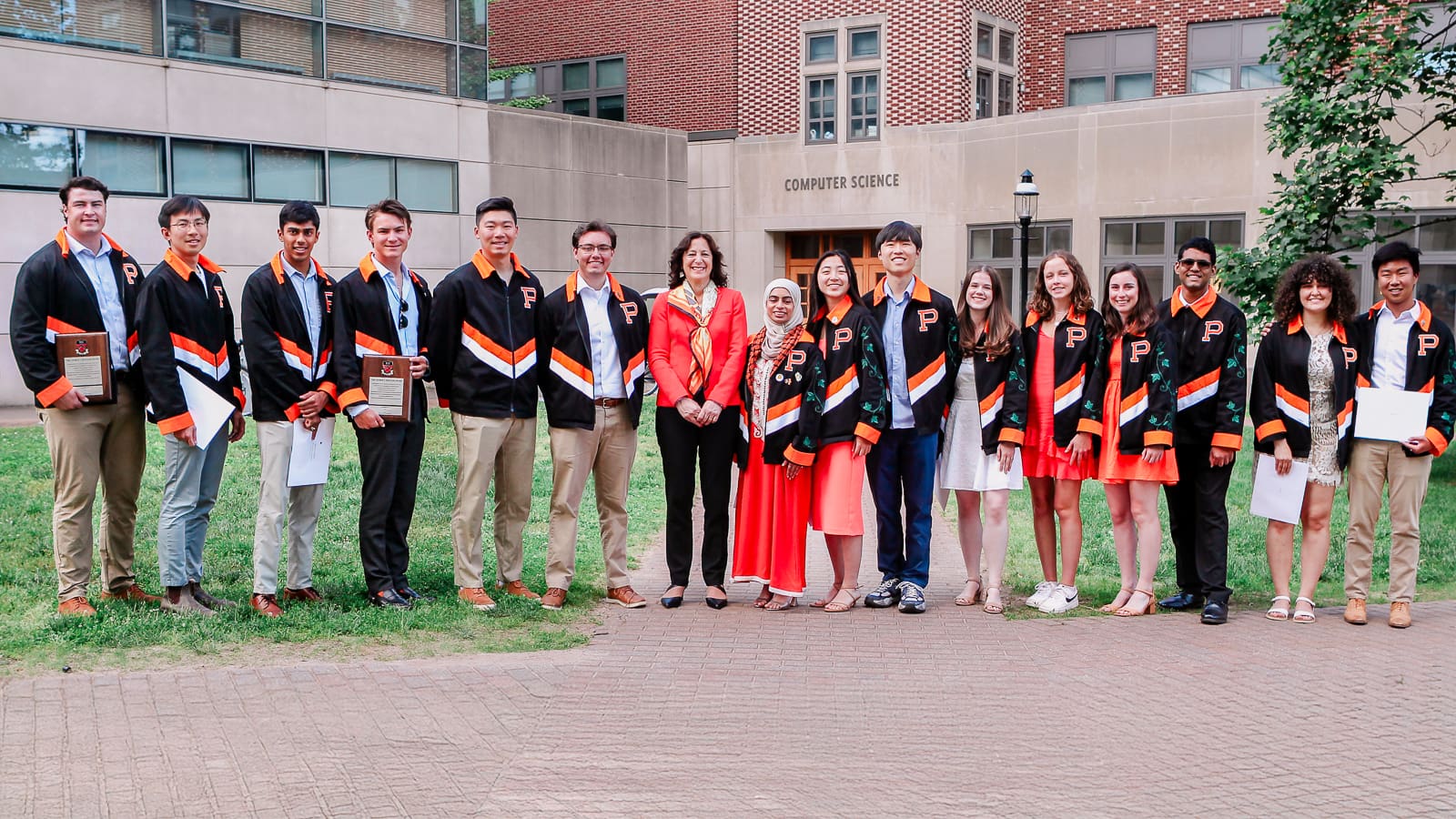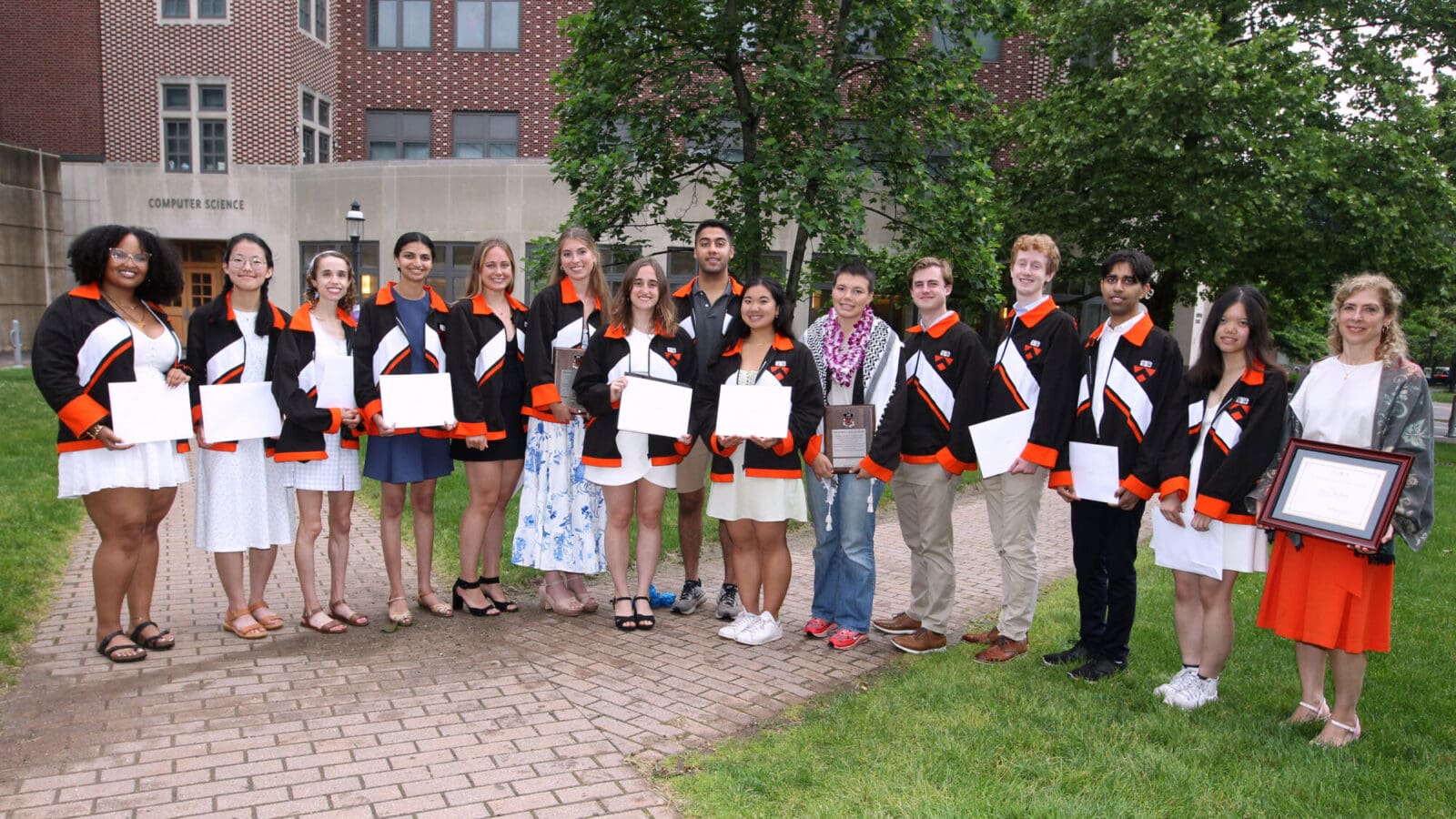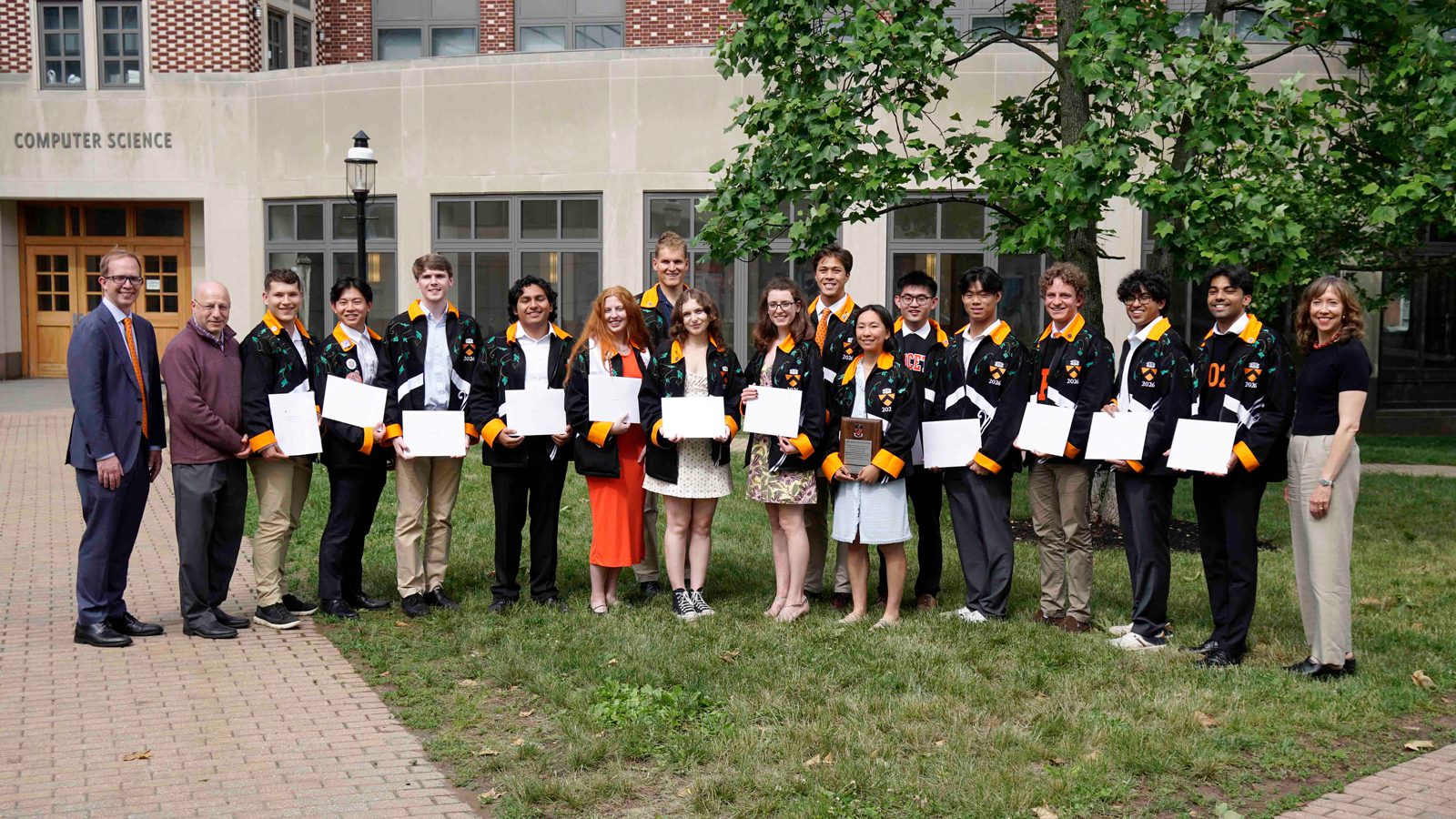
Dean Andrew Houck congratulated engineering graduates on their many accomplishments during the Class Day ceremony and encouraged them to rely on their strength and curiosity to adapt to a changing future.
“This fall, when I addressed the incoming class, I encouraged them to embrace uncertainty,” said Houck, the Anthony H.P. Lee ’79 P11 P14 Professor of Electrical and Computer Engineering. “At Princeton, and in life beyond Princeton, the right answer is often unknown.”
“Fortunately, we have equipped you not just with technical skills, but with the tools you need to navigate an uncertain and changing landscape — because definitionally, fields in engineering aim to cause change, and therefore must always adapt to change,” he said.
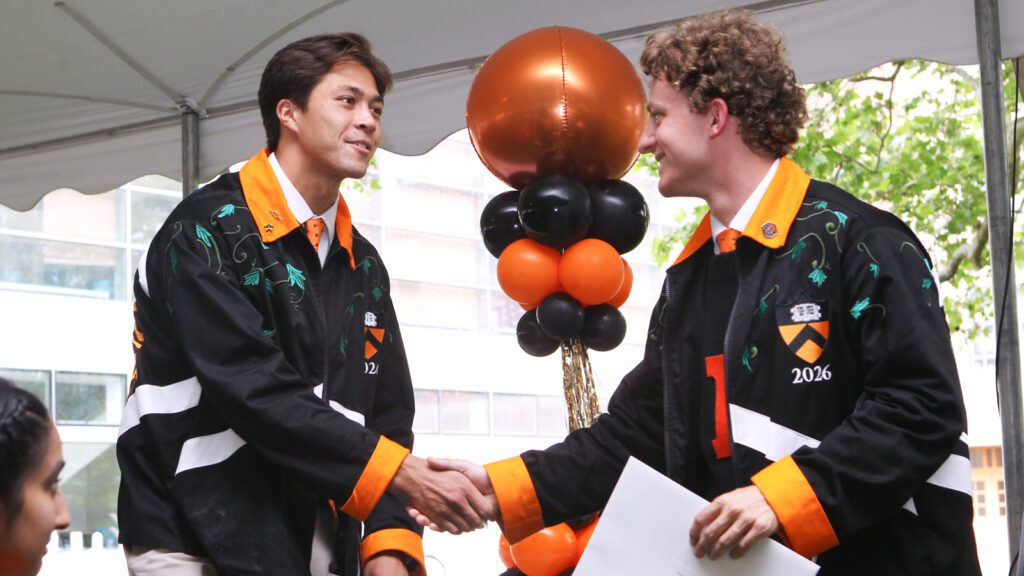
The 473 members of the engineering class gathered with friends and family in the Friend Center courtyard on May 25 for the Class Day ceremony. Before honoring the achievements of the class in academics, athletics and service, Houck told the audience that this year’s graduates could move beyond Princeton with confidence.
“If all you learned here at Princeton were narrow skills, progress would inevitably lead to obsolescence,” he said. “Fortunately, I hope you can see that we have helped you find far more: deep foundational knowledge, the ability to make connections and think critically, a sense of service and responsibility, strength in collaboration and communication, and the confidence to adapt and learn as the world continues to change.”
Referring to class members as “incredible engineers and even more incredible humans,” Houck told graduates to be proud of their achievements but urged them to but urged them to temper pride with humility and curiosity.
“I found that some of the most valuable discoveries in my life required me to look past these brief moments of pride and make sure to maintain humility and curiosity,” he said. “Humility, because it opens you to the possibility that you might be wrong, that you still have room to grow, and that everyone has something valuable to share with you. And curiosity, because you can continue to find good answers, so long as you keep asking good questions.”
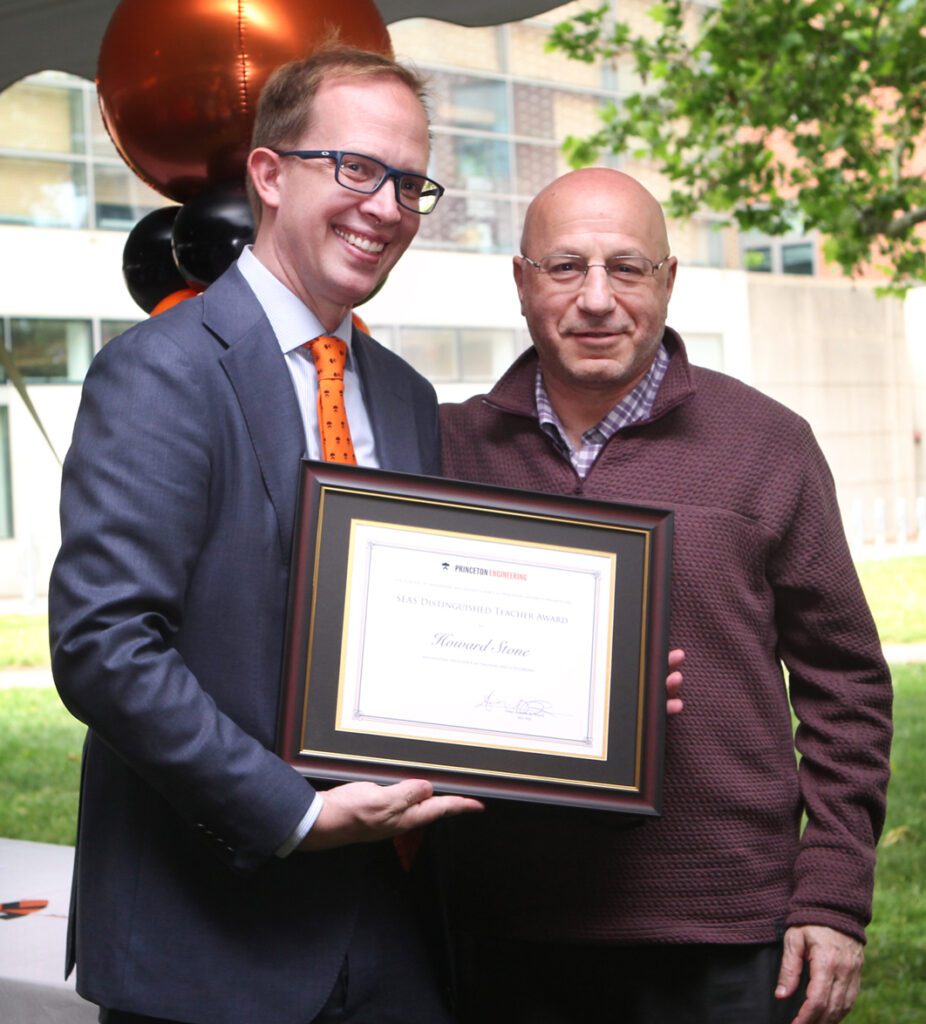
The Class Day ceremony also honored Howard Stone with Princeton Engineering’s annual Distinguished Teaching Award, presented by vice dean of engineering Gabriele Villarini. Stone, the Neil A. Omenn ’68 University Professor of Mechanical and Aerospace Engineering, was honored for his dedication to teaching inside the classroom and beyond.
Villarini noted that Stone teaches two highly regarded and enrolled courses each year, mentors students and delivers sold-out holiday science lectures to the community with a focus on children.
“What makes Professor Stone a truly distinguished teacher is how much he cares about teaching. His desire to engage and improve upon his already excellent and impactful teaching is perhaps more impressive than the teaching itself,” said Villarini, professor of civil and environmental engineering and the High Meadows Environmental Institute. “Simply stated, he is one of the most outstanding educators at Princeton.”
The winners of major awards at the 2026 Princeton Engineering Class Day, as presented by Associate Dean for Undergraduate Affairs Cecily Swanson, were:
THE J. RICH STEERS AWARD
Awarded for scholastic performance that demonstrates the potential for future engineering study and practice
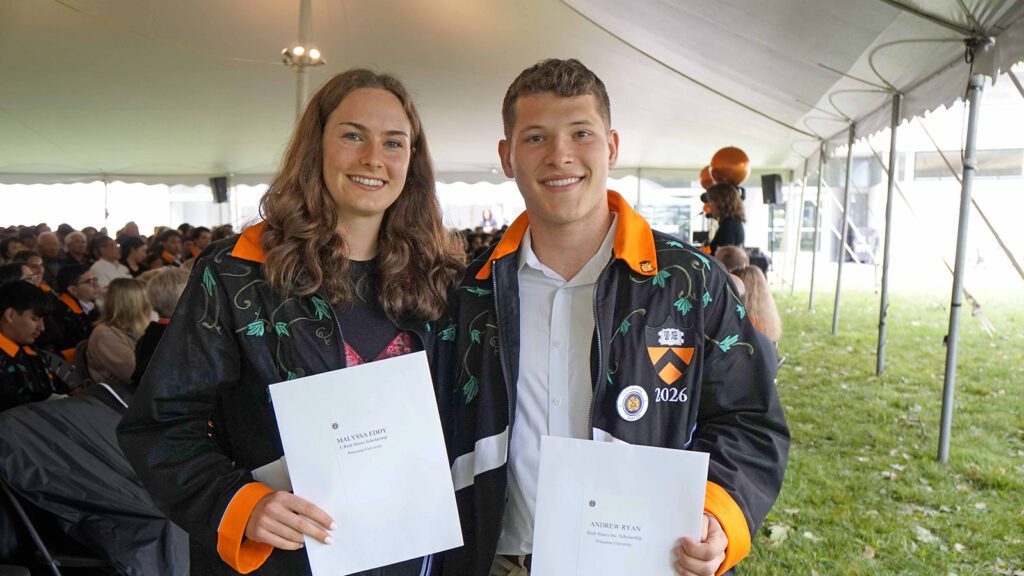
Malyssa Eddy
Eddy, who majored in mechanical and aerospace engineering with a minor in optimization and quantitative decision science, served as a U.S. Air Force Officer Training Corps member at Princeton University. For her senior project, she worked with two peers to develop a robotic manipulator that replicates the dexterity and functionality of the human hand. After graduation, Eddy will pursue a masters in electrical and computer engineering at the Georgia Institute of Technology.
Andrew Ryan
Ryan, who majored in chemical and biological engineering with minors in engineering physics and material science & engineering, served as a Naval Reserve Officers Training Corps member at Princeton. His thesis offered an “Energetic Examination of Oxygen on Diamond (100) Surfaces,” with important implications for quantum sensing and computing technology. After Princeton, Ryan will begin serving as a Naval Reactors Engineer.
JEFFREY O. KEPHART ’80 PRIZE IN ENGINEERING PHYSICS
Awarded to the outstanding student in the Engineering Physics program as determined by the Engineering Physics faculty
Pranav Mathur
Mathur majored in electrical and computer engineering with minors in engineering physics and computer science. His thesis explores the numerical design of robust operations in quantum computing. Mathur’s adviser, Professor Jeff Thompson, remarked that “by discovering new design methodologies,” Mathur’s work “advances the state of the art in the field.” In the fall, Mathur will pursue a Ph.D. in the quantum science program at Harvard.
THE TAU BETA PI PRIZE
Awarded to the graduate who has significantly contributed a major part of his or her time to service to the school
Christopher Chen
Chen majored in operations research and financial engineering with a minor in computer science. Swanson said Chen “has been incredibly helpful at the School of Engineering and ORFE events, serving as an approachable and friendly face for younger engineering students. Chris’s warmth and generosity of spirit are evident to all who meet him.” His thesis analyzed how a capacity-constrained market maker in the investment-grade corporate bond market should decide whether to accept or reject incoming trade opportunities. After graduation, Chen will work as a quantitative trader with Susquehanna.
Veronica Cope
Cope majored in civil and environmental engineering with a minor in architectural engineering and a minor in classics. She served as both communications chair and co-president of the Princeton chapter of the American Society of Civil Engineers (ASCE), and as an ambassador for her department. Cope’s senior thesis explored the “Structural and Historical Study of Wind-Arch Interactions of the Los Angeles Airport Theme Building.” After graduation, she will work as a Civil Engineering Analyst for Kimley-Horn.
THE JOSEPH CLIFTON ELGIN PRIZE
Awarded to a senior who has done the most to advance the interests of the school in the community at large
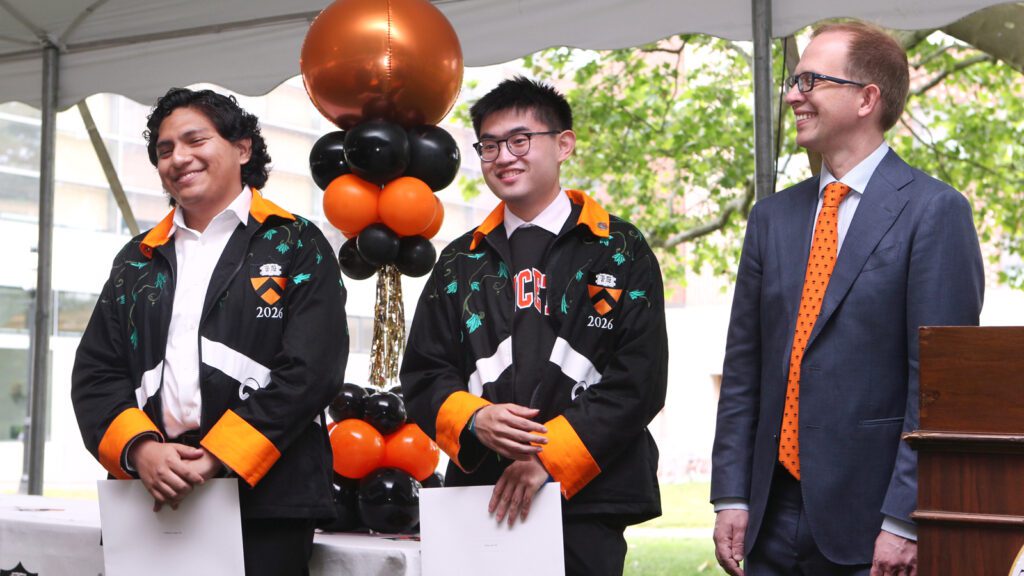
Elliot Lee
Lee majored in operations research and financial engineering with minors in global health and health policy, quantitative economics, applied and computational math, and bioengineering. He conducted thesis research of enormous community impact. In the summer of 2025, Botswana’s government declared a national emergency due to medicine shortages across the country. Lee’s thesis developed a practitioner-facing web application for officials from Botswana’s national health system to use to manage the country’s supply of antimicrobial products. The tool is now being finalized for deployment by health officials who will be able to use Lee’s optimization model to inform on-the-ground decisions about the procurement, distribution and storage of medicines across 619 health facilities. Lee will study health economics as a predoctoral fellow at University of California-Berkeley. He is a certified emergency medical technician and aspires to go to medical school after his fellowship.
Anthony Lopez
Lopez majored in chemical and biological engineering. His thesis, “On the Flow-Induced Control of Particles and Complex Structures,” addresses a central engineering question, of whether flow fields can be designed not merely to transport matter, but to program the organization of matter. The research provides significant implications for targeted drug delivery, biosensing platforms, and the fabrication of advanced soft materials. Lopez served as a peer academic adviser, a peer health adviser, and the secretary of Princeton’s chapter of the American Institute for Chemical Engineers. After graduation, Lopez will work as an implementation consultant for Fast Enterprises.
THE GEORGE J. MUELLER AWARD
Recognizes a senior who has combined high scholarly achievement in the study of engineering with quality performance in intercollegiate athletics
Theodore Bell
Bell majored in mechanical and aerospace engineering and rowed on the men’s heavyweight crew team. Bell is a two-time winner of the Henley Royal Regatta and a three-time sprints medalist, with three seasons in First Varsity and a three-time IRCA first team All-American. He is also a two-time U23 Rowing World Champion for Great Britain. Head coach Greg Hughes said Bell was “most complete student athlete” he has worked with in his career. For his senior thesis, Bell, along with his colleague, Owen Rulyak, sought to design, manufacture and test a lean direct injection combustor — an extremely ambitious project. After Princeton, Bell will work as an engineer for Cambridge Aerospace.
Christina Li
Li majored in operations research and financial engineering with minors in art history and French language and culture. A walk-on, Li was a coxswain for Women’s Openweight Rowing and coxed boats that medaled at every Ivy League championship since her first year, including two gold medals. Her thesis analytically assess the “Value of Art,” using quantitative and qualitative data sets to quantify the “role of gender in the valuation of art and how that valuation has changed over time and geography,” a project that, in the words of her thesis adviser Professor Alain Kornhauser, demonstrates “deep engagement and contribution” to both ORFE and the humanities. Li will work as an investment analyst for PRINCO.
THE CALVIN DODD MACCRACKEN SENIOR THESIS/PROJECT AWARD
Recognizes the senior thesis or project work that is most distinctive for its inventiveness and technical accomplishment
Sonia Hasko
Hasko majored in chemical and biological engineering with a minor in material science and engineering. Her thesis on “Dissolution of amorphous solid dispersions across broad parameter space in semi-infinite slab simulations” is, in the words of her adviser assistant professor Michael Webb, a “tour de force of coarse-grained molecular simulation.” Hasko’s research addresses an important problem in pharmaceutical materials: how drug, polymer and water control the dissolution of amorphous solid dispersions. Webb notes that “we are currently preparing a manuscript based on aspects of her thesis for peer-reviewed publication, and I expect the methodological developments to warrant an additional publication.” This fall, Hasko will enter the Chemical Engineering Ph.D. program at MIT.
Cynthia Jacobson
Jacobson majored in civil and environmental engineering with minors in sustainable energy and music theater. Her thesis, titled “Modeling Synergistic Cooling Benefits of Photovoltaic Green Roofs Across U.S. Climates,” developed a model for photovoltaic green roofs that can be used for any location across the world and then applied the model to generate important insights into green roof design configurations for different climates. Her thesis adviser, Professor Elie Bou-Zeid, described the “remarkable” impact of Jacobson’s work, which “fills a critical gap in the field” and will soon be submitted for publication. Jacobson will work as an environmental engineer intern at the New York City Department of Environmental Protection within the Bureau of Water and Sewer Operations.
Alexander Liou
Liou majored in mechanical and aerospace engineering with a minor in robotics. For his thesis on “Design, Fabrication and Validation of a Blended Wing Body VTOL Unmanned Aerial System for Adverse-Terrain Payload Delivery,” Liou designed and built an efficient and compact uncrewed aircraft system and then conducted a successful series of test flights, demonstrating its predicted performance. Liou’s thesis adviser, Professor Luigi Martinelli, praised his dedication, determination and ingenuity: “Throughout the project Alex mastered the simulation-based design process and interdisciplinary skills needed to be a superior aeronautical engineer in the 21st century.” Liou will work as a mechanical engineer for Anduril Industries.
THE LORE VON JASKOWSKY MEMORIAL PRIZE
Recognizes a student who has participated in research that has resulted in a contribution to the field, has added to the quality of University life, and intends to pursue a career in engineering or applied science
Edward Deleu
Deleu majored in electrical and computer engineering with minors in computer science and materials science and engineering. His thesis on “Strain Engineering of Transition Metal Dichalcogenides” elucidates how “band alignment and mechanical strain influence carrier transport and bandgap modulation.” His thesis adviser, assistant professor Saien Xie, describes how Deleu’s “technical skill, creativity and perseverance distinguish him at the very highest level.” As sophomore, Deleu worked in associate professor Minjie Chen’s lab, making scientific contributions to the MagNet Project. As a junior, Deleu undertook a research project under the direction of Professor Ravindra Bhatt, which resulted in findings that have “the potential of solving a discrepancy that has existed for 30 years” and which are being prepared for publication. This fall, Deleu will begin a materials science and engineering Ph.D. at Stanford.
Devan Shah
Shah majored in computer science with a minor in mathematics. His thesis on “Provable Distillation of Observable Systems into Linear Dynamical Systems” represents, in the words of his thesis adviser Professor Elad Hazan, a “profound contribution to the field of theoretical machine learning, demonstrating a level of technical sophistication and independent initiative that is rare even among more advanced students.” The results, with Shah as first author, were published in NeurlPS (a top-tier conference in machine learning.) Shah also served as the president of the Princeton chapter of the Association for Computer Machinery. He will work as a quantitative researcher for Jane Street.
JAMES HAYES-EDGAR PALMER PRIZE IN ENGINEERING
Awarded to a student who has manifested excellent scholarship, a marked capacity for leadership, and promise of creative achievement in engineering
Braeden Carroll
Carroll majored in civil and environmental engineering and wrote a thesis under the direction of Professor Branko Glišić on “Assessing the Contributions of Plank Walls to Shear Stiffness in Heritage Timber Frame Barns.” His thesis “creates significant new knowledge with outstanding impact,” contributing “not only to understanding how to preserve historic barns as a signature rural cultural heritage of the U.S. but also how modern timber structures should be analyzed and preserved (as in the new ES & SEAS building on our campus),” wrote Glišić. Carroll was a member of the Men’s Lightweight Rowing team. He was awarded the Moses Taylor Pyne Prize, the highest general distinction conferred on an undergraduate, as well as the George B. Wood Legacy Junior Prize and the George B. Wood Legacy Sophomore Prize. Next year, he will travel to France as a member of the inaugural cohort of the Lafayette Fellowship, a new program offered by the French Embassy. While in France, he will study for a master’s degree in science and technology at École Polytechnique, specializing in the engineering, economic and geopolitical challenges of the energy transition.
Alex Tseng
Tseng majored in electrical and computer engineering with minors in sustainable energy and computer science. His senior thesis on “Bidding on Tomorrow: Dispatch Algorithms for Energy Storage Resources” develops a high-performance forecasting and stochastic optimization method for model predictive control of energy storage resource dispatch in power markets. His faculty adviser, associate professor Jesse Jenkins, said the work “could form the foundation of a practical and economically competitive method for battery dispatch.” Tseng co-founded a startup called WattOur in which he is leading a group of Princeton students in developing software for energy grid modeling. WattOur has won several grants at Princeton and was recently accepted into the prestigious accelerator program Y Combinator. Tseng is also an engaged member of the Princeton University Energy Association and an Orange Key Tour Guide. The recipient of a Schwarzman Scholarship, Tseng will spend next year earning a Master of Global Affairs at Tsinghua University.