A few minutes into a recent lecture, engineering dean Andrew Houck proposed finishing his talk by leaving the auditorium through two separate doors simultaneously.
Some in the audience, a group of first-year students and their parents, chuckled. Others looked a bit perplexed. They had come for an academic lecture to welcome them to Princeton. Did lectures typically involve magic tricks?
It wasn’t magic, Houck explained. It was science.
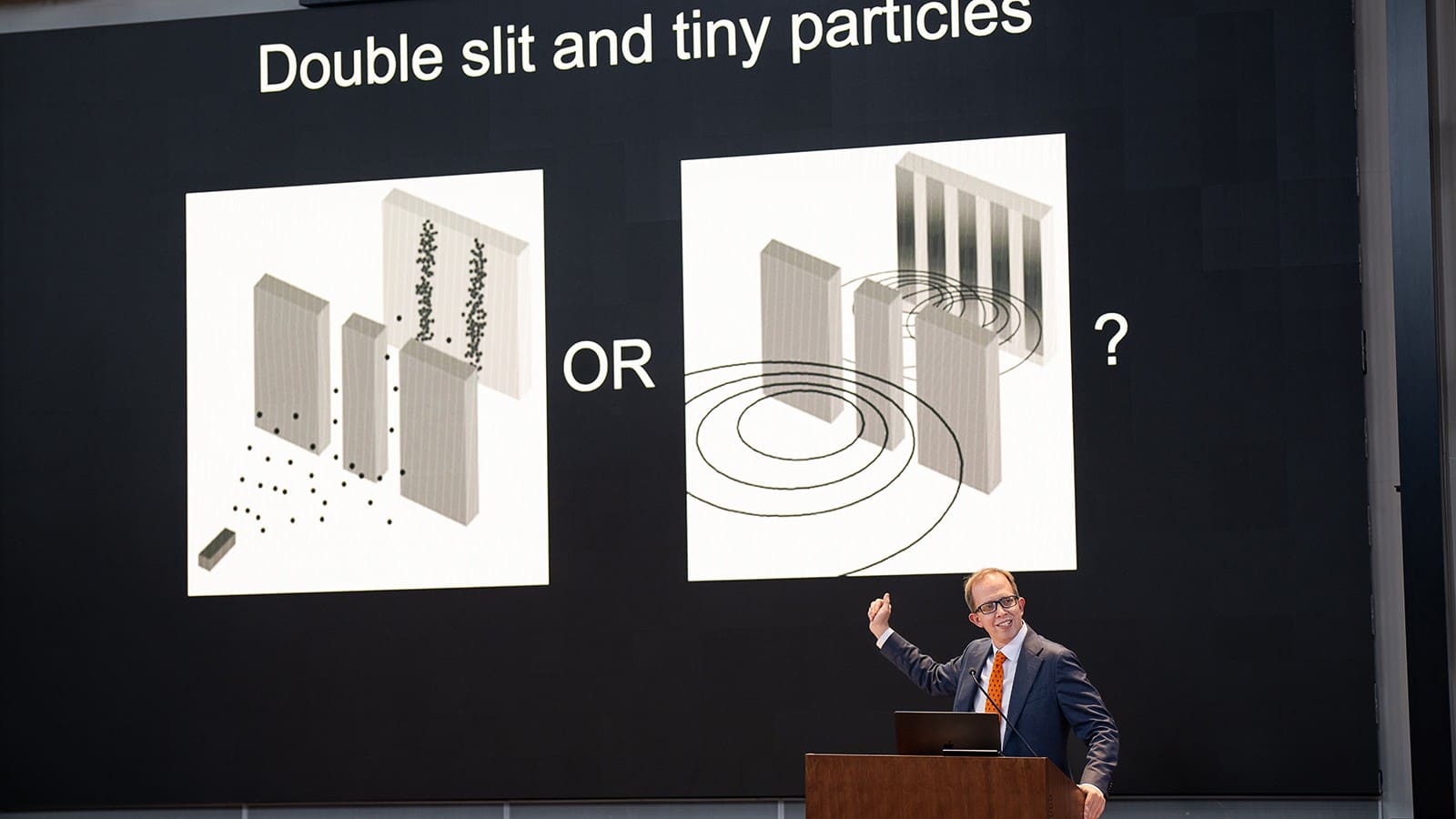
Besides serving as dean, Houck is a leading researcher in quantum mechanics, the branch of physics that deals with objects at atomic and subatomic scales. The trick he was describing mirrors a classic quantum experiment. The double-slit experiment, first performed in the 19th century and extended during the 20th, demonstrates that particles such as atoms and photons can exist in two states simultaneously. Like Houck’s proposed trick, a single atom can pass through two different openings at the same time.
The idea that he could pull off the same feat as a single atom in the experiment was “seemingly nonsensical,” Houck said. But the ability for atoms, electrons and other particles to exist in two states, called superposition, is measurable.
“The reason you find this weird is not because quantum mechanics is any weirder than any other bit of science you’ve ever learned,” said Houck, Princeton’s Anthony H.P. Lee ’79 P11 P14 Professor of Electrical and Computer Engineering. “It’s that your senses have evolved to perceive things on macroscopic scales, on the scales of humans.”

In the double-slit experiment, Houck explained, a single silver atom passes through a plate with two slits as a wave. Like pebbles dropped into a pond, the peaks and troughs of the wave create a pattern on the opposite side of the plate. When researchers shoot an atom at the plate, it creates an interference pattern indicative of two waves. But when the researchers add detectors to the other side before firing the atom, the interference pattern disappears. Instead, each atom seems to pass through one slit or the other. Scientists call this the wave-particle duality, in which atoms, electrons or photons can sometimes behave as a wave and sometimes as a particle. The wave interference pattern is evidence of superposition.
Quantum superposition is one of the key principles that could enable quantum computers to solve currently “impossible” problems, Houck told the audience at the First-Year Family Weekend event on Friday, Nov. 7.
Houck has studied quantum science for more than 25 years, since he graduated from Princeton with an electrical engineering degree in 2000. He’s seen — and helped enable — the growth of a quantum computing industry. He continues to grapple with the mysterious reality that underlies the physical world, even as he works to apply this knowledge.
“It’s a moment for you to pause and reflect on the wonder in absolutely everything in the world that you’ve grown bored of because you’ve seen it over and over … because everything is just as weird as this,” said Houck. “But I’m also an engineer, so I’m going to turn this into technology.”
A quantum computer consists of qubits, or quantum bits, which afford a degree of complexity that classical bits, with their 0 and 1 states, cannot manage. Some problems, like simulating complex systems of atoms and molecules, would require a classical computer to run for a billion times longer than the age of the universe, while a quantum computer could theoretically solve them in a few hours, said Houck.
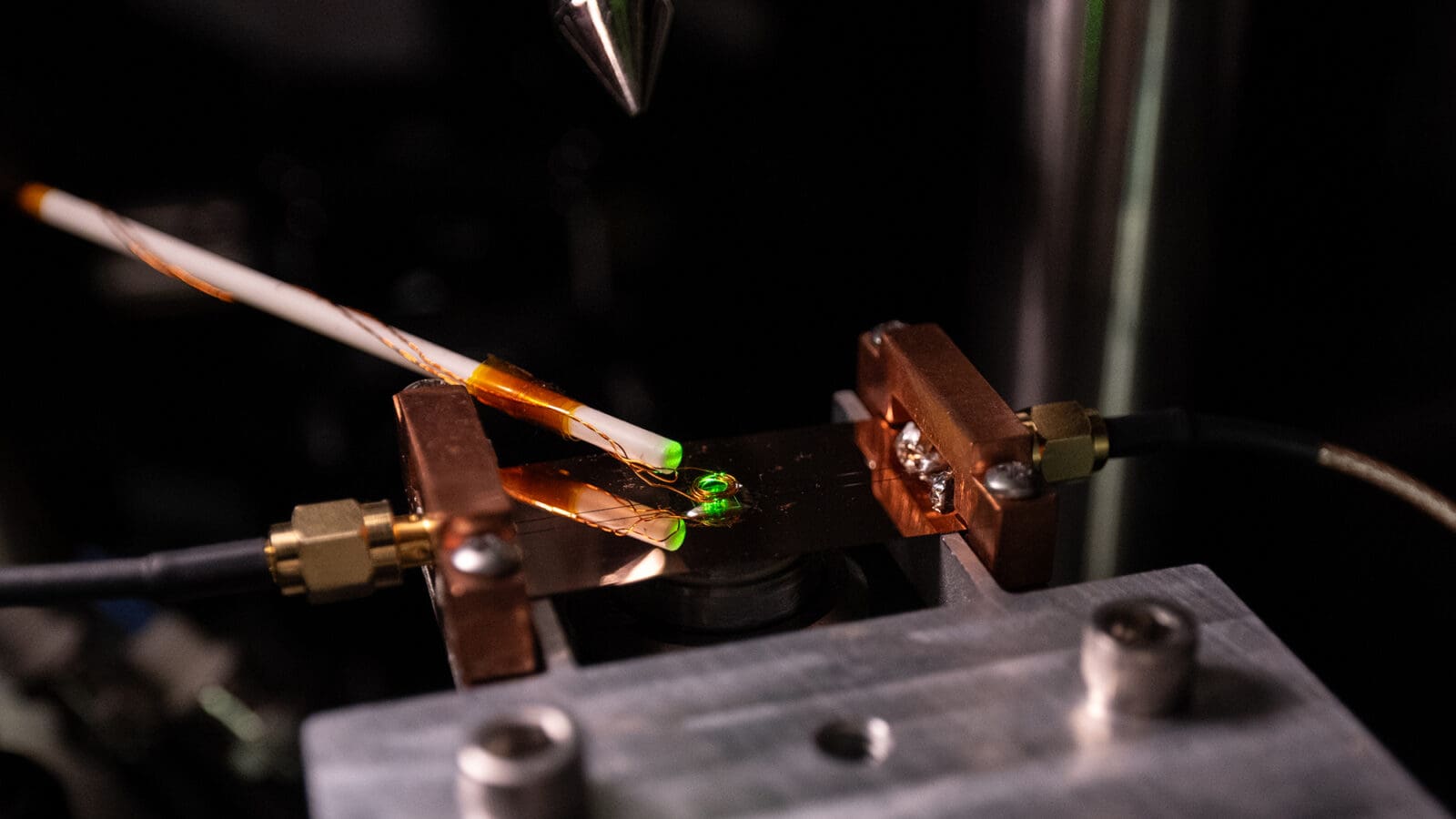
Today’s quantum computers are not powerful enough to solve such problems, in large part because qubits are exquisitely sensitive to minute changes in their environment and their superposition states collapse quickly. In a step toward overcoming this challenge, Houck and his colleagues recently developed a new type of qubit with a lifetime of more than 1 millisecond — three times longer than the best reported in a lab setting, and nearly 15 times longer than the industry standard for large-scale processors.
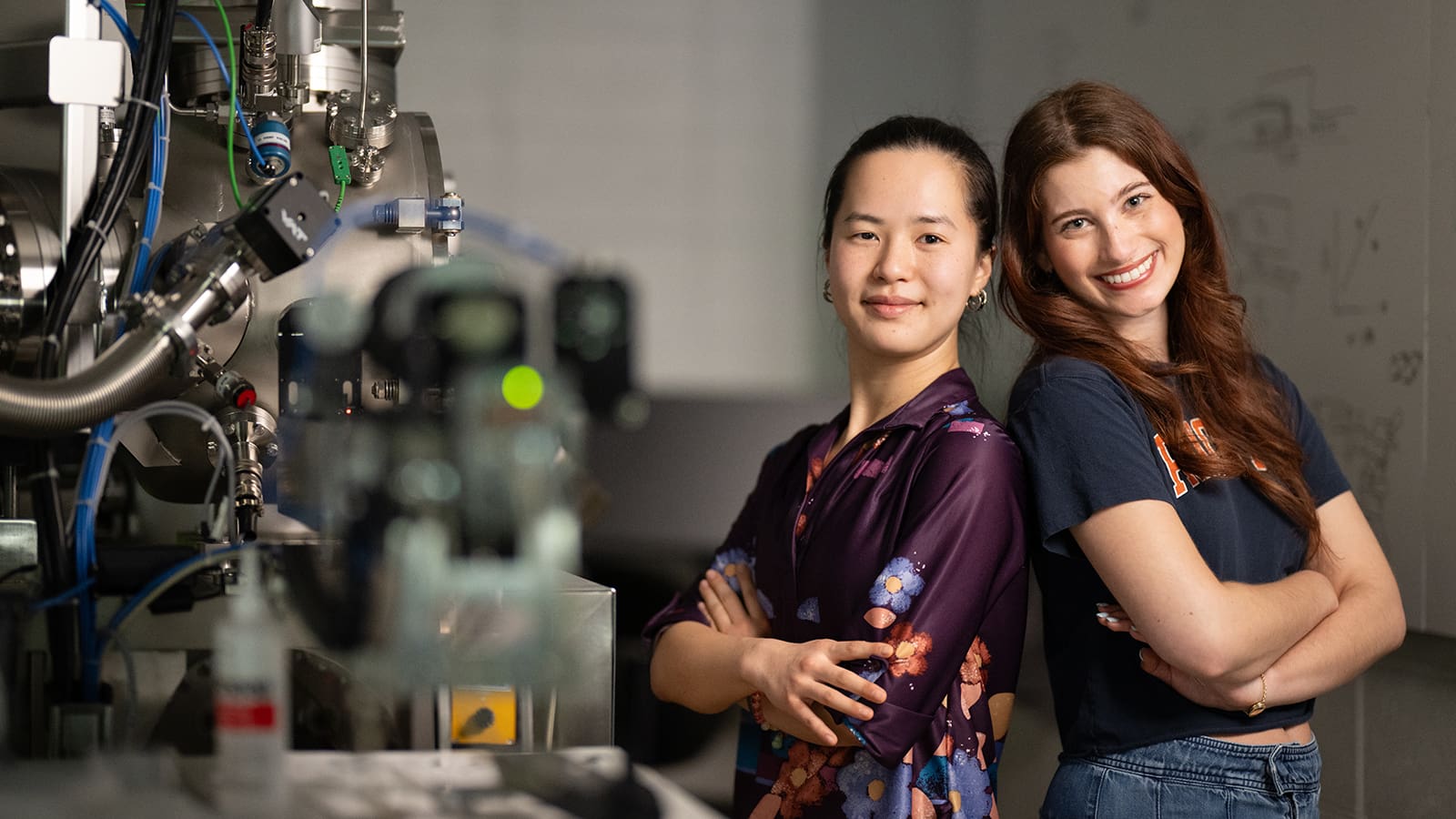
This milestone emerged from a collaboration between Houck’s group and electrical and computer engineering professor Nathalie de Leon, as well as Robert Cava of Princeton’s chemistry department.
“Academic collaboration allows you to do things that even billion-dollar industry groups can’t do, because the kinds of connections you can make in an academic environment are really different,” said Houck.
The new qubit is one example of the type of innovation supported by the Princeton Quantum Initiative, co-directed by de Leon and physics professor Ali Yazdani.
By bringing together researchers from different fields around shared goals, said Houck, the initiative is addressing some of the “big open questions” in making quantum technologies practical. These include searching for new qubit materials that are immune from noise, developing diamonds as quantum sensors, and exploring the electronics and architecture of quantum computers.
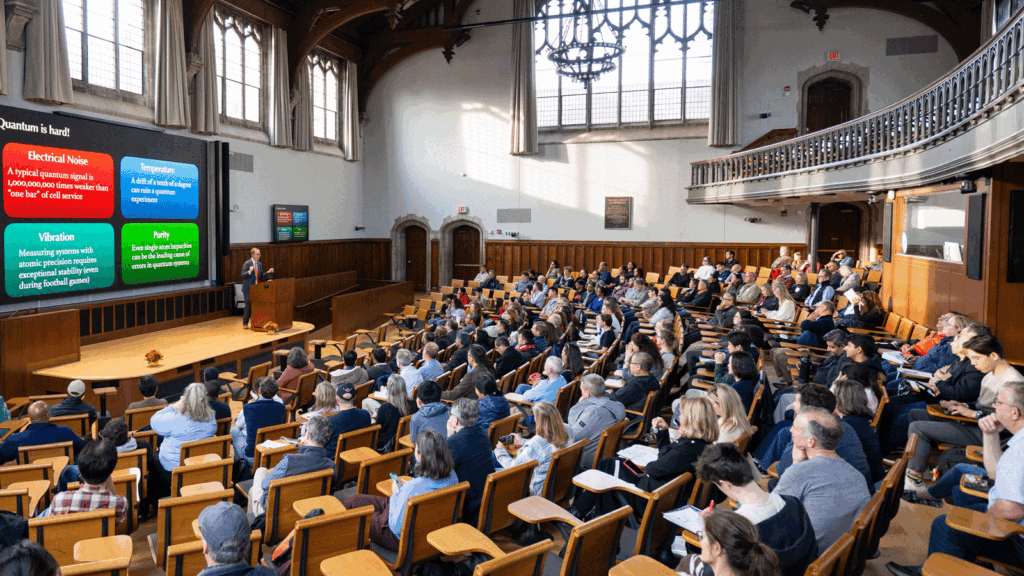
On the education side, in 2023 Princeton launched one of the first Ph.D. programs in quantum information science and is working toward offering an undergraduate minor, said Houck. Courses and research opportunities abound, and a Quantum Institute building is under construction near Princeton’s baseball fields.
While state-of-the-art facilities are critical, he said, “often your best ideas come from a degree of connectivity to people around you,” enabled by the ability to communicate across disciplines, which is “the ethos of [Princeton’s] liberal arts education.”
This ability is among the most valuable skills that undergraduates of any major gain during their time at Princeton — a skill that’s becoming “even more valuable in an era where AI can actually solve narrowly defined problems,” he said.
Houck answered audience questions about the intersections between AI and quantum computing, the challenges of scaling up the technology, the philosophical debates inspired by quantum mechanics, and the specific types of problems quantum computers might solve.
“They’re not like a magic tool that will make everything possible. They are a particularly specialized tool that will make certain problems solvable,” he said. “They’re not good for solving everything. But where’s the fun in that?”