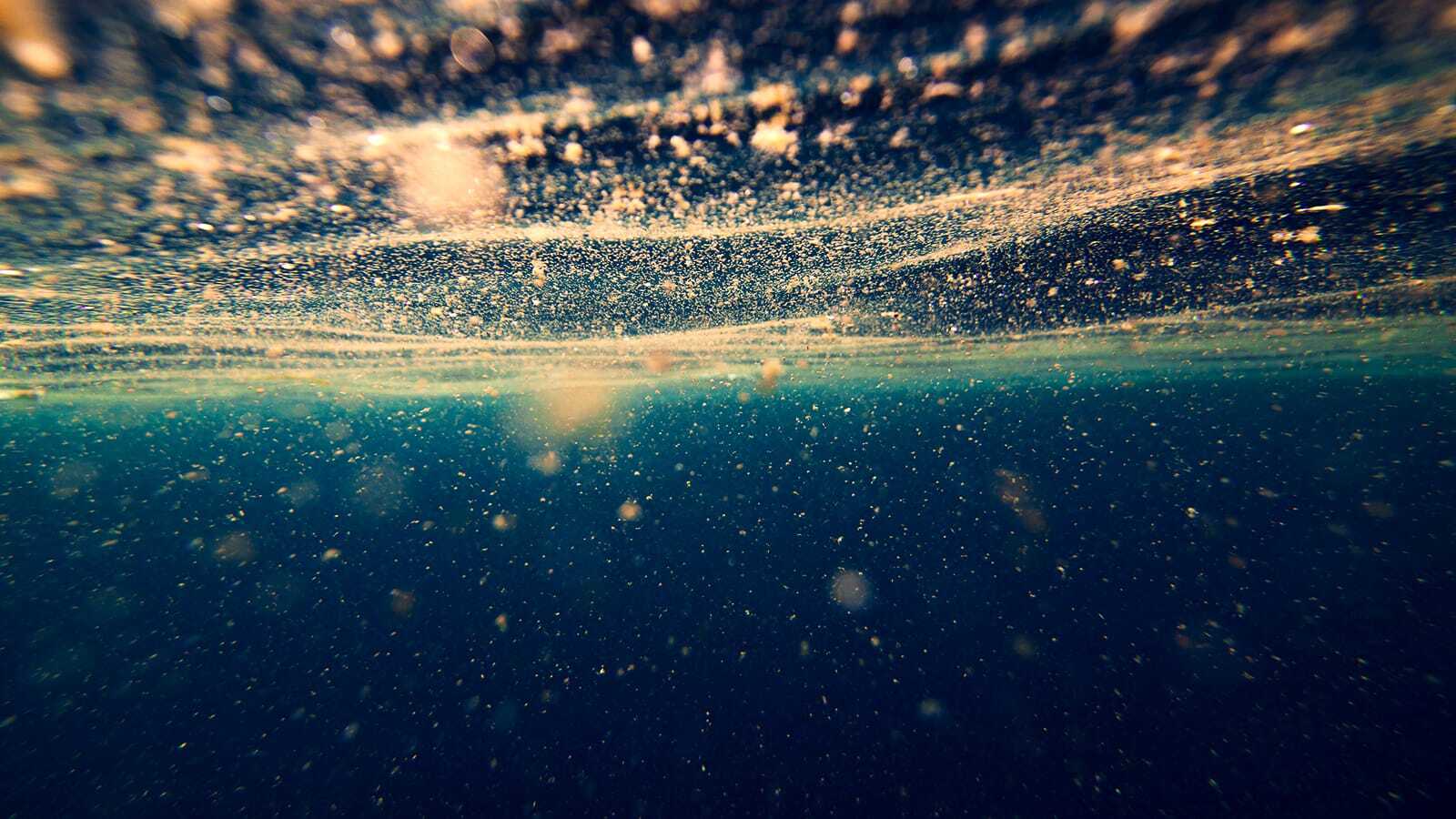
People assume plankton just go with the flow, but a new study has found the opposite. Some plankton rotate their bodies against the current when rising to the surface, a strategy the researchers dubbed surfing.
The study looked at larval snails — one of many species of plankton — in a tank that mimics ocean turbulence. Michelle DiBenedetto, an assistant professor of mechanical and aerospace engineering and the study’s lead author, observed the snails tilting their bodies against the swirling current. Rather than letting the current spin them around, they oppose the flow’s rotation by leaning against it. This causes them to move toward the rising part of the flow and avoid the downward part, allowing them to ride the flow up toward the surface, sometimes doubling their speed.
DiBenedetto said the snails’ rotation could be a strategy to reach the surface to find food, or it could just be that they’re trying to stay upright in turbulent ocean eddies. “They’re definitely actively rotating against the flow,” she said. “But we don’t know why for sure.”
The paper was published Dec. 19, 2025, in the Journal of Experimental Biology.
DiBenedetto studies how small things in the ocean, like microplastics, sediment and microorganisms, interact with large ocean flows. This includes exploring how the transport of plankton, which are mostly carried by currents, is influenced by subtle swimming behaviors.
In recent years, scientists theorized that plankton may be able to exploit ocean turbulence to gain significant speed or change direction. Until now, the concept was based on simulations and lacked evidence from living organisms.
DiBenedetto said it’s not clear from her experiments if the snails are surfing the turbulence on purpose, or if it’s an unintended consequence of opposing the flow for another reason. “If you are in a turbulent ocean, it can feel like you are in a washing machine, and you don’t necessarily know which way is up,” she said.
DiBenedetto is planning more experiments to understand surfing and the motivation behind it. She also wants to experiment with different species of plankton to find out if the surfing behavior is shared broadly, or if it’s unique to larval snails.
Modeling how plankton move through the ocean is important for ecology, fisheries and climate science, since plankton transport shapes marine food webs and the life cycles of many organisms.
Understanding how plankton interact with currents can also inform designs for small autonomous vehicles, according to DiBenedetto. Turbulence is usually considered a problem, especially as engineers build smaller and smaller robots. “Instead of that turbulence working against you and being a nuisance,” she said, “the animals have found a way to take advantage of it.”
The paper “Plankton active response to turbulence enables efficient transport” was published Dec. 19 in the Journal of Experimental Biology. Besides DiBenedetto, authors include Rémi Monthiller and Christophe Eloy from Aix-Marseille University and Lauren S. Mullineaux a biologist at Woods Hole Oceanographic Institution. The study was funded by the Woods Hole Oceanographic Institution, the National Science Foundation, the European Research Council and the Princeton University Library.