Charles Schroeder, an expert in polymers and soft materials whose work has allowed scientists to study the dynamics of single molecules and molecular interactions in extraordinary detail, joined the Princeton Engineering faculty on Aug. 1.
Schroeder, a professor of chemical and biological engineering, joined Princeton from the University of Illinois at Urbana-Champaign, where he was the James Economy Professor in the Department of Materials Science and Engineering and a professor of chemical and biomolecular engineering; and where he held multiple leadership roles at the Beckman Institute for Advanced Science and Technology.
“Charles brings a level of expertise in characterizing soft materials that keeps our department at the forefront of this field,” said Christos Maravelias, chair of the Department of Chemical and Biological Engineering and the Anderson Family Professor in Energy and the Environment. “Over the past 20 years, he has led the way in studying the dynamics of single molecules and understanding how small particles interact. He has also demonstrated an unusual ability to collaborate with researchers across traditional boundaries using many different approaches. We are thrilled to have him.”
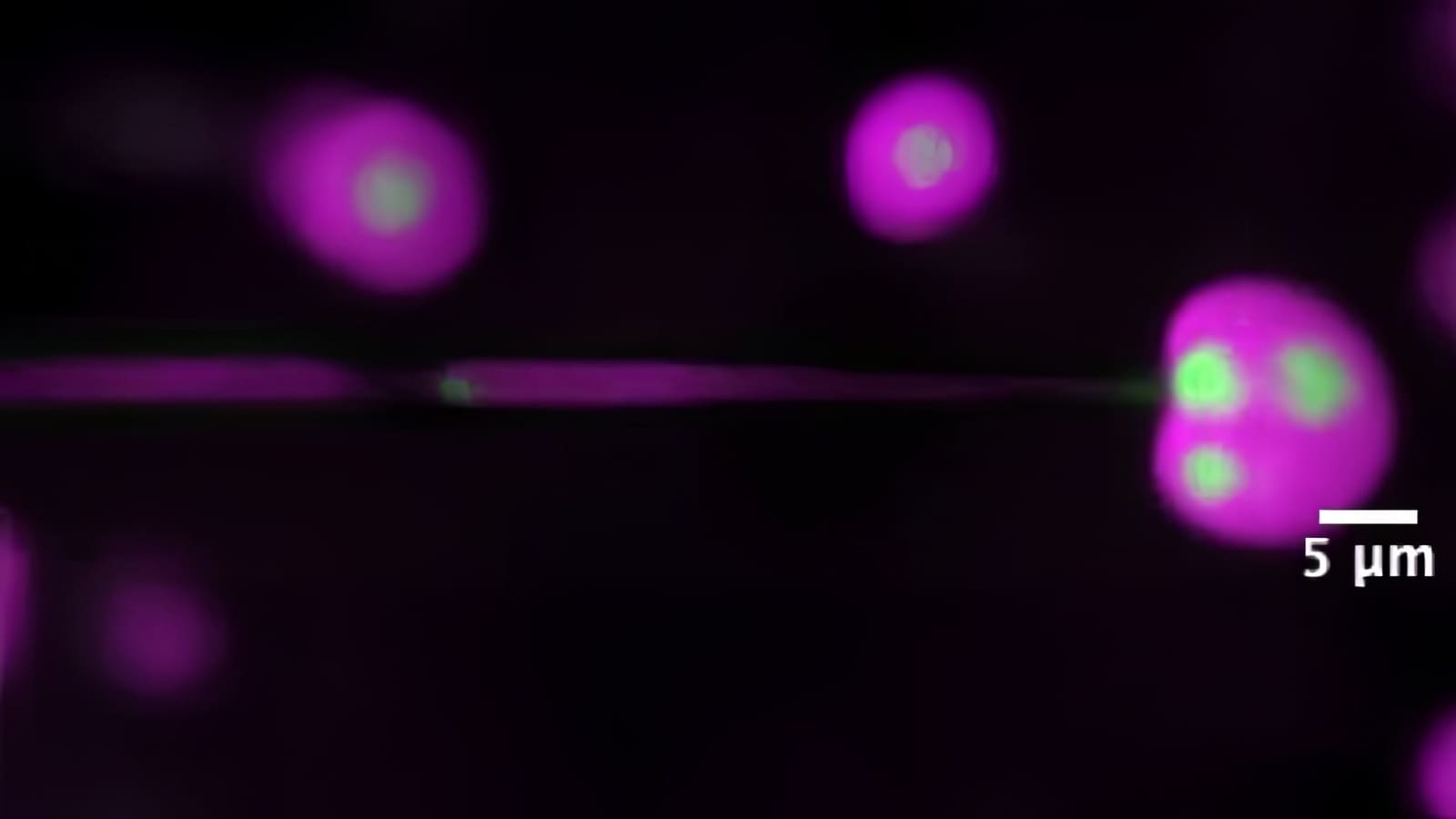
Beginning in 2010, Schroeder and colleagues developed a method to trap single molecules, such as DNA, and other small particles using automated flow control. Known as the Stokes trap, the device allows scientists to study target molecules in extraordinary detail and to explore their minute interactions with other molecules and external forces. This method provides an alternative to using optical tweezers, electric fields or acoustic fields to trap small particles. Unlike an optical trap, the Stokes trap uses gentle fluid flow, good for handling delicate biomolecules, and can be adapted with relative ease to study multiple particles and their interactions.
Schroeder’s work engages both experimental questions and the underlying theoretical principles that describe the material systems he’s interested in, spanning topics from commercial polymers to the lipid materials that make up cell membranes to the complex inks used in advanced manufacturing.
“This department has always had a rich history of fundamental and scholarly research in the area of soft materials and fluid dynamics,” Schroeder said. He said that history and the strong culture of collaboration at the department’s core made it an ideal fit.
Since arriving at Princeton, he has established collaborations with three departmental colleagues. One of those collaborations, a National Science Foundation-supported study, focuses on a new class of synthetic polymers that replicate themselves like DNA and show promise as self-healing materials. The project involves researchers with expertise in theory, computation and complementary experimental techniques.
“Our research aims to understand sequence-structure-function relations in materials,” he said. “If we change molecular sequence or structure, how does that change properties?” That deep understanding can lead to powerful new ways to create materials with capabilities that seem plucked from science fiction. To Schroeder, ideas like self-replicating synthetic materials don’t seem nearly as crazy as they sound to the average person, because he’s seen the data, and he knows from experience what great teams can achieve.
Schroeder is a fellow of the American Physical Society, the American Association for the Advancement of Science and the Society of Rheology. His past honors include a Packard Fellowship, a Camille and Henry Dreyfus Teacher-Scholar Award, an NSF CAREER Award and selection into the National Academy of Engineering’s Frontiers of Engineering program, among many others. He earned a Ph.D. from Stanford University and held postdoctoral fellowships at Harvard University and the University of California, Berkeley before joining Illinois in 2008. He is an associated faculty member in the Princeton Materials Institute.