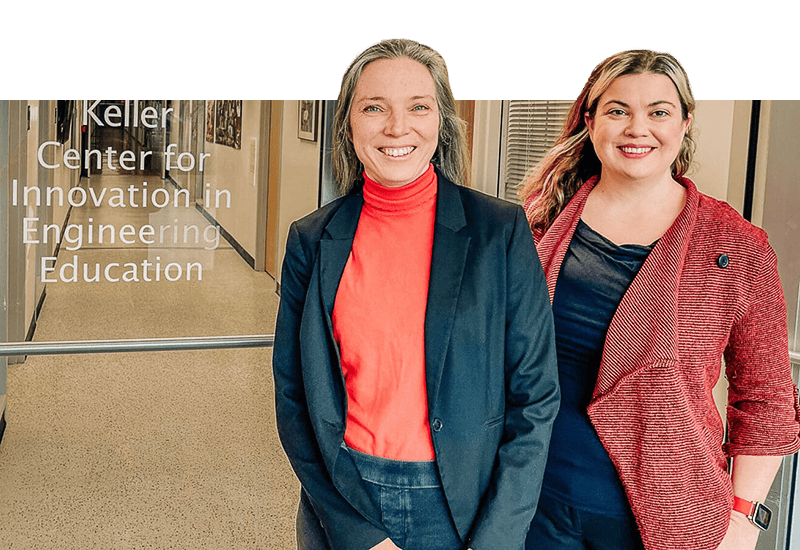
The Keller Center for Innovation in Engineering Education is now offering a Minor in Design, a program of classes and hands-on work that introduces undergraduates to designing physical products, artworks, digital tools, policies, or organizational structures with the intention of changing entrenched ways of thinking or jumpstarting action.
Open to students of all majors, the new minor combines rigorous techniques from multiple academic disciplines to guide students to conceptualize, prototype, test, and critique their ideas.
“Our exciting new Minor in Design offers students the opportunity to focus their interventions in real-world settings, giving them the tools to create and grow impact,” said Janet Vertesi, associate director of the Keller Center and associate professor of sociology. “We are bringing together faculty and community across campus and beyond to tap into Princeton’s spirit of service and innovation and take it to the next level.”
The minor will require five core courses plus a project: a 100-level introductory design course (EGR 107); an upper-level course in histories, theories, and practices in design; two topical courses from a list of more than 40 compiled from partners across the arts, architecture, social sciences and engineering; and a project-based course in which students work in teams to help community organizations address challenges. Students will also develop a capstone independent project to extend work from a previous class or from other independent academic work for their portfolio.
The new minor represents an important area of growth for the Keller Center, which also offers a Minor in Technology and Society and a Minor in Entrepreneurship, said Sigrid Adriaenssens, director of the Keller Center and Ritter Professor of Civil and Environmental Engineering. The tech and society minor focuses on understanding the current and historic relationship between society and technology, while the minor in entrepreneurship focuses on creating sustainable, scalable organizations, whether for-profit companies or nonprofit. The new design minor fills a role that is, in a sense, between these established minors, said Adriaenssens. Bringing together the humanities and the social sciences, the arts, architecture, and engineering, it asks students to robustly investigate the social context of societal and engineering problems, then to intervene in those patterns to improve their trajectory.
Overall, the Keller Center’s programs seek to extend technical problem-solving to include critical, humanistic thinking, and structured approaches that enable students to have positive impacts far beyond their academic disciplines.
“At the Keller Center, we are preparing students across campus to build what matters. We are creating new opportunities to engage with complex real-world challenges, learn to navigate ambiguity with rigor and imagination, and work across disciplines to create meaningful impact,” said Adriaenssens. “The new Minor in Design is an exciting moment for our community, and we look forward to seeing how these students will shape the future.”
To support its new and revised programming, the Keller Center has moved to the newly renovated 110 Prospect Avenue. (Join Keller’s Open House at its new home at 1:30 p.m. on Thursday, Sept. 3)
The new minor also reflects a broad strength at Princeton Engineering in cross-disciplinary research and teaching, said Andrew Houck, dean of the School of Engineering and Applied Science: “Most of the hardest problems require us to draw on expertise from across traditional disciplines. This new design minor helps students learn how to think both rigorously and creatively to weave disparate ideas together.”
The Keller Center has been building a roster of design courses for nearly a decade, and students often have cited these courses as transformative.
Sarah Phillips, a senior majoring in history of science with a minor in entrepreneurship, said the Keller Center course “Creating Deep Change” led her to a “complete reframe” of how she thinks and approaches problems.
That class is taught by Kees Dorst, the James Wei Visiting Professor in Entrepreneurship and a widely published author in the field of design. Dorst introduces students to a structured approach to conceiving change as they work in teams to help community organizations break through deep-seated challenges.

Phillips, who also is CEO of the nonprofit Girls Into VC, said the class taught her to pause and ask more fundamental questions about the problems in front of her. “These are steps I never thought of before, to be honest,” she said, noting that her mind was geared to do what had worked through her life so far, which was to anticipate and solve problems as quickly as possible.
In class, she initially struggled to appreciate the practical use of theories about how to dig deeper into problems. “The first three weeks are incredibly challenging,” she recalled. Later, however, “aha” moments came as she and her classmates interviewed leaders of community organizations and as she reconsidered her own conception of Girls into VC, which aims to help young women access the world of venture capital. Phillips said she realized she had become “bogged down in the numbers” as the organization expanded rapidly from 10 to 33 chapters with 11,000 members. Instead, she said, Girls into VC needed to meet a more open-ended challenge of fostering community and empowering new generations of leaders within the organization.
Stepping back and taking time to embrace uncertainty is a total change in “the inner workings that happen in my brain now,” she said. “It’s okay to be in the uncomfortable gray zone. And I wish people would take this class and could feel that because now I think differently and I respond differently.”
Gary Smith, who graduated with a B.S.E. in computer science in May, said he immersed himself in Keller’s design courses late in his undergraduate years and is excited for future generations of students to enroll in an official minor.
“Design is everyone’s business,” said Smith said. “Design to me is a careful attention to the details involved in the creation of something.”
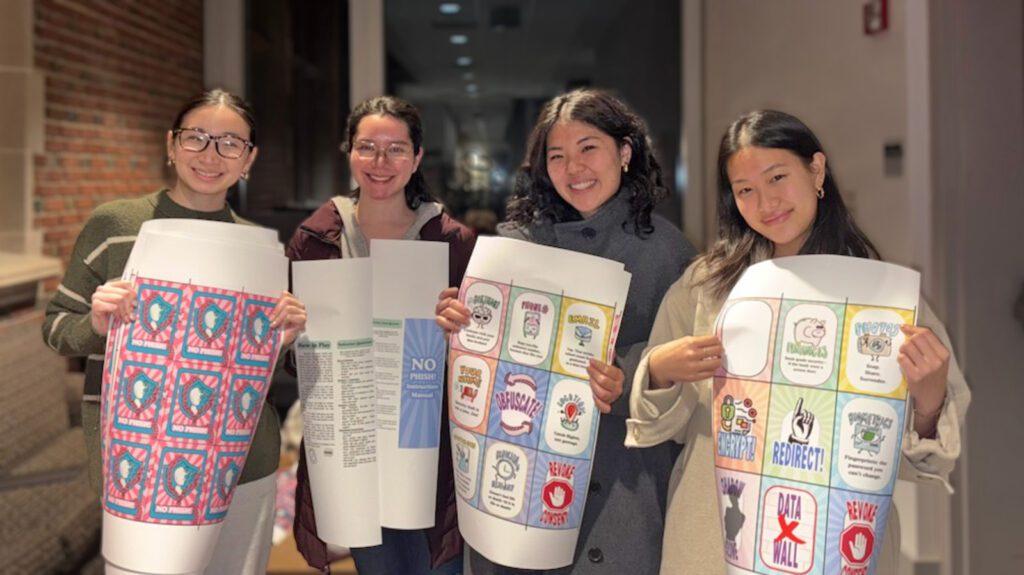
Smith said he came into Princeton with experience in the tools and techniques of visual design and computer interfaces. As he explored classes, he realized that the Keller Center was offering ways to push beyond technical considerations and to ask, “How do you improve the world with design and think more critically about what you’re making?”
Smith is now starting a job at Figma, a web-based design tool company. An ability to think broadly about design problems is particularly important in today’s age of AI and other powerful tools, Smith said, because the bottleneck for tech firms is no longer the cost of developing new products but rather deciding what to build in the first place.
“The design minor isn’t to teach you the practice of art or the practice of graphic design,” he said. “It should help you think about what you want to create in the world and how to best effect the change that you want.”